Wednesday, July 14, 2010

Carolyn Haines: TOURING THE DELTA WHILE THE COAST FAILS


I’ve just returned from a whirlwind book tour through the Mississippi Delta to celebrate the launch of BONE APPETIT, the 10th book in the Sarah Booth Delaney Delta mystery series. That triangle of rich, flat land that extends south of Memphis down to Yazoo City and from the Mississippi River east to the hills has become my second home. 

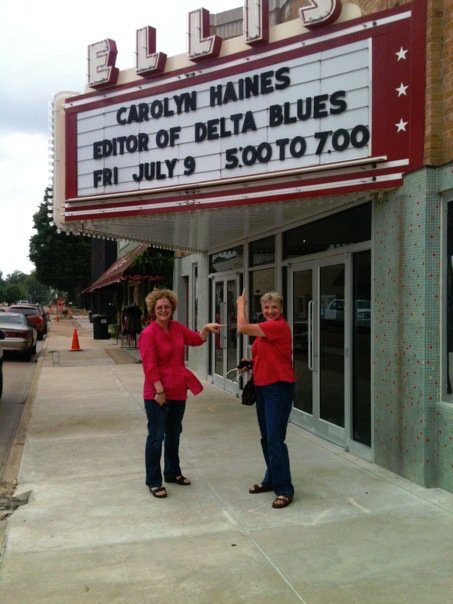
I did double duty on this tour, because I also signed copies of DELTA BLUES, a collection of short stories I edited centered around the Mississippi Delta blues and a crime noir element. Short story contributor to the anthology, Alice Jackson, was my traveling companion and co-signer and we were also joined by short story author Suzanne Hudson. Suzanne had more sense than to ride with us—but she joined us for the signings at Greenville, Greenwood, Vicksburg, Cleveland and Jackson (all in Mississippi).

BONE APPETIT has numerous scenes set in the Alluvian Hotel and the Viking Cooking School—and as part of the fun, I assisted the resident chef in a cooking class on Friday. We made three delicious appetizers and I didn’t even blow up a single oven! But I have to say, I might enjoy cooking more if I had some of that state-of-the-art equipment. And the class was a delight. Fun, light-spirited and with a real “can do” feel.

But some of the most fun was cutting up with my long time buddy, Alice. We have known each other for over thirty years, and we grew up together in the newspaper business. We took completely different paths, but we have remained good-natured, teasing friends. The Facebook pictures we posted along the way give an indication of how much we torment each other—and what fun we have doing it.

Driving across the Delta (repeatedly!) I surprised myself with the way I’ve come to know this part of the world and to view it as “mine.” I take an interest in new development in the small towns we drove through, in the state of the highways, in the height of the cotton.

Beverly Moon took us to a new juke joint, Po' Monkey’s, and we learned that just last month Eric Clapton put in an appearance there. The Delta is a strange and magical place where anything can happen.

While we were in Greenwood, the film crew for THE HELP was gearing up. And there was a film crew from Wisconsin filming webisodes in the cooking school. Greenwood has suddenly become (much like the contestants in the book) very filmable.
For any student of Mississippi history, the Delta towns have always been an interesting mirror of the soul of this multi-cultural state. The Delta is only one region, but for many decades it was the seat of power, the place of big money and big land and big cotton. In Greenwood, life is good this summer.

There’s a sharp contrast at work here. The Gulf coast, home of casinos and the fishing industry, is shrouded in disaster. The oil spill has taken over everyday life. How will this oil affect this region—which hasn’t even really begun to recover from the effects of Katrina. It is heartbreaking to watch the destruction. And worst of all is not knowing when it will end.
            
On a personal note, this was one of the best book tours I’ve done. Good company, good food, good bookstores, and great people. I have laughed for a week, and I have also managed to avoid the news. But I am home now, and I look out over my pastures and my horses and I worry. Great changes are taking place in this land that I love. No one is certain of the extent of the environmental damage that this oil gusher will produce. Only one thing is certain: the coast is forever changed. I don’t like this. I don’t want this. And the only thing I can do is write about it.

Monday, July 12, 2010

A good setting is more than trees and couches

BY AD HUDLER


I started writing fiction after moving from Minnesota to Macon – largely because I was so intrigued and  entranced by my new surroundings that I wanted to share it with the world.  Macon was so unlike any place I’d ever lived … like it was another country or planet. Even the soil was red, like the surface of Mars.

So … to make a mid-size Georgia city even more interesting as a setting for my novel (Southern Living,  Ballantine Books) I decided to relocate an immense Toyota plant there, and bring 3,000 transplanted workers from New Jersey into the heart of Georgia.

Can you say “conflict?” Can you say “Southern culture under siege?”

So … how could I best create a setting for this? Instead of describing the landscape with normal descriptions I used a different device. You know how so many southern newspapers have those columns in which people call in, anonymously, and say anything they want to? In Macon, it was called Straight Talk, and I think it painted an emotional landscape of the city and region that was crystal-clear. So … I decided that for my novel I’d create the “Chatter” column in the Selby (Georgia) Reflector. I started each chapter with two or three of these made-up tidbits.

Dear Chatter: I don’t believe one word of that story in the Reflector that talked about pig guts being just like human guts. Maybe your editors need to read the Bible more. God created Adam, and it’s Adam's job to eat that pig. Remember that.

So what does this say about the setting of the town in the novel? It hints at how strong religiosity is in Selby … and maybe shows that there’s a conservative element living there as well.

Here’s another:

Dear Chatter: To all the people who broke the hair-bow chain letter we sent: I just wanna say thanks for ruining my little girl’s day. We were counting on those hair bows.

Dear Chatter: What is it with all the grown women wearing hair bows on Sunday?

Obviously, this shows that people believe in dressing up in Selby on Sunday, and it also shows that there’s a new, curious, skeptical element in town: those Yankees who don’t understand Southern Culture. These Chatter items also show the love of textiles and fabrics and adornment that Southerners love. (Hey, who can forget Scarlett and those curtains?)

Dear Chatter: If a vampire can’t see himself in a mirror, how does he comb his hair? How does he get to looking so nice?

This shows a sense of humor and wonderment in a way that you only hear in the South. Kind of South Park meets Flannery O’Connor.

Dear Chatter: I’m wanting to know who makes the best chitterlings in Perry County, and do they do takeout?
And:
Dear Chatter: The difference between margarine and Crisco is that margarine’s yellow and has salt. You can always add yellow food coloring to the Crisco.

Obviously, this shows the reader a little about the food culture and state of health and exercise (hey, unfortunately, most of our southern states lead the country in just about every health-related comparison)… and they realize that chitterlings are common enough of a staple that someone would even presume  that they’d be available in takeout form.

Dear Chatter: I’m absolutely amazed at how you Southerners can find Jesus and God’s hand in everything. Let’s get some things straight: God has nothing to do with you winning the lottery or the raise you get at work, I’ve lived in Selby for six months now, and sometimes I feel like I’m living with wild natives of some third world country.

Obviously, this shows the un-religious ways of the Yankees who have moved to town … and shows how the cultures are clashing.

Dear Chatter: I’m thinking you need to change the Selby Reflector’s name to the Ebony Reflector.

Ah, yes. Racism. Part of every culture and urban landscape, be it North or South.

Dear Chatter: There is no justice in the world. A security guard who carries a gun is selling his sister’s soul, and I have proof, but the law can’t do anything. The person he sells it to has money – so can someone tell me what to do?

I took this one verbatim out of the Macon newspaper column. I thought it reflected a sense of frustration and helplessness in the working class culture. I also just thought it was funny and odd!

Dear Chatter: The Southern way is to live and let live, so for all you Yankees who don’t like the way we do things down here, I’ve just got one thing to say: Delta is ready when you are.

I thought this showed how non-confrontational and polite Southerners are, even when they feel their culture is being threatened. The caller could have been meaner but instead approached his anger in an oblique manner.

I guess what I’m trying to say is that setting is more than landscape. A big part of a successful setting is the words that come from the peoples’ mouths who live there.
Setting is more than trees and doilies and dried pimiento cheese in the kitchen sink. 

Ad Hudler’s most recent novel is “Man of the House,” published by Random House. He is currently on his Tailgate Tour 2010, visiting Pulpwood Queens throughout the South, who chose his book as their July pick. In this month’s Oxford American he has an essay titled “Tree Bitch.” He blogs at AdHudler.com 

Sunday, July 11, 2010

THE RIVER
Patti Callahan Henry


“….And the river, even when frozen, arrives at the right place….” Thomas R. Smith

I didn’t write those gorgeous lines. They are from a poem titled TRUST by Robert R. Smith.

But if the subject this month is Writing Struggles, this is what I have to say about struggles in my writing – Even when it is frozen, it arrives at the right place.

Yes, it’s easy to trust in the metaphor when everything is working and the story unfolds and the plot offers me themes and wonderful words, but sometimes of course that doesn’t happen. Sometimes we stand on the riverbank of our story and can’t see anything while we’re stumbling and grappling for vision. The reason I love this river vision for the writing life is because I love rivers.

I don’t know why I love rivers – I didn’t grow up on one or raft down one (unless you count college and the Chattahoochee, which is another story). I wasn’t saved and baptized in the muddy waters. But rivers carve through my soul the same way they carve the land through which they move. For hours I  on a riverbank and watch the water moving by, going somewhere, to some final destination which is predetermined or…maybe not.

I swim in its waters without being able to see what is below the surface. Tidal rivers are my favorite – the way the water swamps the land and then exposes the mud, oysters and life below the surface. I watch it flow over rocks and barriers; I see it nourish the land and the life within. Rain falls into its waters and lightening flickers against the surface.

The river is a living thing, trying to tell me something, but I’m not wise enough or connected enough to understand its language. But every once in a while, in a quiet moment, I’ll hear that river.

So I realize – this is the same way I feel about my writing struggles. I show up on the writing riverbanks every day and hope to hear the words and story. Where is it going? What does it have to say? Are there turbulent or calm words to this part of the story? Is there a storm or a sunset? Is the water pink with twilight or grey and disturbed?

This is the way it is with my story: It might take me hours or weeks or months or years to find out what it is saying – but I still want to show up. I might not know the waters final destination, but I’ll keep going. I might not yet understand what the low tide will reveal, but I’ll wait. There might be rocks and storms and diversions, but my words will ‘arrive at the right place’.

It’s hard – the waiting and the struggle – but what is the other option? To not show up at the riverbank. And that, for me, is not an option.


And here is a picture of my favorite river. Now who woulnd't want to stand at that riverbank?

Patti Callahan Henry is the NYT bestselling author of six novels: LOSING THE MOON, WHERE THE RIVER RUNS, WHEN LIGHT BREAKS, BETWEEN THE TIDES, THE ART OF KEEPING SECRETS and DRIFTWOOD SUMMER.

Her Holiday Novella THE PERFECT LOVE SONG: A HOLIDAY STORY, will be out October 12th.

www.patticallahanhenry.com

Friday, July 9, 2010

Telling a Story at The Monti

Growing up, I was always happy when we were invited over to the Waughs’ house for supper. Mrs. Waugh was the only person I knew who still made country ham and red eye gravy, but that was not the main attraction. The main attraction was her husband, Jim Waugh, who ranks as one of the best story tellers I ever knew. After supper, he’d stretch with his hands on the back of his neck. He’d get a certain knowing twinkle in his eye and look around at all of us as we waited to hear what tale he’d tell—maybe it would be about his time as a soda jerk in his hometown drugstore or maybe it would involve some ornery so-and-so he’d met on the road selling pharmaceuticals, or maybe (this was my favorite) he’d tell about how he met and fell in love with the prettiest little girl he’d ever seen.

I remember how the room would go still as he was talking, how we would all together be transported back to the place and time he described. I’d watched carefully because I wanted to be able to tell such stories myself. I was hoping that I growing up, I would encounter some interesting things to tell stories about and that I would learn how to tell them –make that room go still.

Honestly, I think I have yet to accomplish this goal. As I grew up, I found that I was terrible joke teller, and while I could tell a tolerable story, it would never live up to the Jim Waugh standard. So, I quit trying to mesmerize my friends over the dinner table and switched over to the written word. On paper, I do better. I can take my time, go back and revise. I can write and rewrite until my story unfolds exactly as I hear it in my mind. I’ve grown accustomed to this brand storytelling, to the idea that eventually, readers will encounter my tale in their own quiet rooms. This is immensely satisfying, and in many ways it beats telling stories in bars and dining rooms--where a tale can be subjected to interruptions and background noise….

So imagine my reaction a few weeks back when Jeff Polish, the founder of The Monti (http://www.themonti.org/ ) , asked me to tell a story at one of his storytelling shows. The rules: my story has to be true, it has to be twelve minutes long, and no notes are allowed. In other words—no hiding! No hiding behind the fiction, no hiding behind a text, and no hiding behind a nice big podium. It’ll be just me and my story. This is a terrifying prospect, but also it is the kind of challenge that I need to take on now and then.

Getting ready for the event has been an interesting process, and it’s been more like my normal writing work than I thought. The story still needed a shape, a beginning, middle and end. It needed a hook, an arc, and a good payoff. I had to review my history for the right details to tell the story. Once I had all of my material gathered and organized in my head, I started telling the story—to myself, to my dog, to every friend who would listen. Towards the end of this week, I had to start bribing my buddies with glasses of wine so they’d listen just to it one more time. Everyone (except my dog) reacted differently to different parts of my tale. This led to many changes in my story—a phrase added here, a section deleted. It was editing with an audience.

My story has gotten tighter, and I hope, better, over the course of this week, but it’s interesting that it will not take its final form until I stand in front of the Monti audience tonight and hold forth. Though I have a good idea of what my story will be, this is not like releasing a book. I’m giving up a measure of control to the moment. There’s something exhilarating about this notion, though it’s terrifying as well. I know that when I walk up in front of people this evening, I will do it in honor of our storytelling friend Jim Waugh. I hope I will do him proud.
Lynn York is the author of The Piano Teacher (2004) and The Sweet Life (2007). She lives in Chapel Hill, NC. Her website is www.lynnyork.com.

Wednesday, July 7, 2010

WRITING STRUGGLES by Jackie Lee Miles

The topic this month is Writing Struggles. That really hits home with me when I finish one novel and have to start another.


I just finished two novels. The first one will be released January 2011 by Sourcebooks: ALL THAT’S TRUE. It follows Andrea St. James (Andi for short), during the first Desert Storm war, who discovers her father is having an affair with her best friend’s step-mother. Sourcebooks calls it “an authentic coming-of-age tale with a terrific takeaway.”

The second novel, HEART, has yet to be sold. It was inspired by an actual CBS news program where a man received his daughter’s heart. The tagline of the book is: After a fatal accident sixteen-year-old Lorelei Goodroe follows the lives of five people who receive her organs, including that of her father who receives her heart.

Okay, two books down, a new one to go. But what to write? After several days of contemplating, I get an idea when a character comes to me, a twelve-year-old girl who has a problem. (I tend to write in young voices—I can’t seem to help myself.) The protagonist’s voice is very strong. I hear her words in my head:

“When I was very little my mother told me stories about why my father wasn’t with us. First she said he was away in the war going on in Asia, Vietnam. Then she said he was healing from the wounds in his head that made him forget us. Later she said he was on assignment for the secret service.”

I used those lines for my opening of SUMMER RIDGE and wrote a tagline: Twelve-year-old Mary Alice Munford struggles with the knowledge that her mother plans to marry her father, a man who abandoned them before she was born.

On to the novel and that’s where the real struggle begins. What to write? What will this girl’s problems be? What will stand in her way? What can you say that will keep your reader riveted for three hundred pages? That’s a tall order, but that’s what books ask of us. And your reader expects some good answers.

Early on, Mary Alice states that her household is not a happy one:

There’s me, my mother, Granny Ruth and Aunt Josie, whose husband, my Uncle Earnest, fell under a combine when I was five so I never got to know him good. The day he died, I climbed on Aunt Josie’s lap and wouldn’t leave even when it was time to go to bed. Mama tried to pick me up.


“You been sitting there all day, sweet thing.”


“Leave me lone, Mama,” I said. “I’m helping Aunt Josie cry.”

I loved this protagonist immediately and started to write, regardless of the struggle.

I’m now two hundred pages into the manuscript. Mary Alice is at a fair with her father, who she still calls Hank, seeing as she can’t think of him as a real Daddy. He has picked up a gal from the local café, Wanda Lou, and the two of them are off having a very good time on their own. Mary Alice is busy pitching pennies and is not doing too well when a man comes up next to her and says, “What are you shootin’ for little miss?”

Mary Alice says he is acting like he really cares. She shows him the two little dogs she has won and points to the large one hanging down from the rafters with a big red bow around its neck.

If I get one more, I can trade it for that big one,” she explains.

That’ll be right nice,” he says and hands her another quarter. “Give her another try.”


She takes the three pennies the attendant hands her and tries again, but one by one the pennies bounce off the plates. The man who gave her the quarter takes hold of her elbow and says, “They got a booth across the way. They use bowls instead of plates. It’s easy to win. Come on, I’ll show you.”


Mary Alice eagerly follows the man who says she can win. He takes her behind all of the tents that are set up in back of the booths. Eventually, he spins around and says, “Sorry girlie, I can’t quite remember where that booth is.”

That’s when he grabs her. Mary Alice heart sinks. She realizes now it was not a good idea to follow him, but it’s too late. He already has his arm around her neck.

That’s as far as I’ve gotten. I’m still struggling and still writing. Please write back to me and tell me what you think. Your responses count!!

Jackie Lee Miles is the author of Roseflower Creek, Cold Rock River, Divorcing Dwayne and the soon to be released All That’s True. Visit the author’s website at http://www.jlmiles.com. Write to the author at Jackie@jlmiles.com.

Tuesday, July 6, 2010

The Christmas of Muscadine Jelly by Kerry Madden


          Sometimes I remember it as the Christmas of Muscadine Jelly, but this really isn’t true. Maybe I just like the way it sounds. It could be called the Christmas of Ritz Cracker Casseroles, but where is the poetry in that? And besides that isn’t true either. What I do remember is this: We drive from Los Angeles to Nashville with our three kids in order to give them a southern Christmas with my husband’s family, but what I’m struggling to write about takes place just after New Year’s in early 2005. I don’t know why the supper in Memphis is what I remember most, but it’s the memory that keeps returning, and since this month’s suggested topics are about writing struggles and/or setting, I thought I would somehow try to write about both.

On the way back to California, we have a post-New Year’s supper in Memphis at the home of my husband’s sister. The supper consists of Ritz cracker casseroles – green beans and cream-of-mushroom soup on a bed of Ritz crackers and sprinkled with dried onions and a broccoli noodle casserole adorned with Ritz Crackers. I’m relieved to have Christmas over, so this dinner is beautiful to me. We dish up cafeteria style, and I’d like to think there is an apple pie topped with Ritz Crackers too, but that is pushing it. 
My sister-in-law who serves this meal is bossy, sophisticated, and has an answer for everything. After a trip to California when she was fourteen, she could dance the jitterbug to perfection across the living room floor. I don’t associate her with Ritz cracker dishes. As a child, I compulsively read cereal boxes, but when I came across a box of Ritz crackers and studied the different recipes for pies and casseroles I was amazed that a box of crackers could do so many things. Who knew? In my house of standard meatloaf and Hamburger Helper dinners, Ritz crackers were served strictly with cheese.
            A salty ham also sits on the table in Memphis next to the casseroles along with red wine. I’m sure there is also either coleslaw or potato salad or deviled eggs, too. It feels slightly romantic to have supper in Memphis with my sister-in-law, a nonstop talker, where conversation is easy because nothing is expected but vague attention. An evening walk would not be noticed or remarked upon so long as somebody is there to catch the avalanche of words, and I begin to look outside with longing. I’m facing three more days in the car with kids, and it’s a balmy Memphis night in January, no sign of winter anywhere except for the way the naked branches of the oak trees claw the sky. I want to pretend that this is a regular Sunday, and that maybe we are lost characters from a Peter Taylor short story having Sunday dinner in Memphis with the relatives. 
My sister-in-law describes the politics of Memphis and some of the underhanded ways of the city and says, “A lot of people in Memphis have three jobs: politician, appraiser, and preacher.” When I laugh she fires back, “That is not funny!” I grow tired. Okay, it’s not funny. I am blending times and dates and years of conversation, but it’s always the same or a very similar conversation, and I have to remember to be bland, to say nothing, to be quiet, to smile only slightly, maybe. I’m her brother’s wife who writes but that is never mentioned. Writing is suspect. It has always been suspect. Writing is not steady. Writing is not something to consider seriously. Writing is okay for some people but it’s better to be a lawyer or a doctor with health insurance than to gamble with something so risky as a writing career. I don’t mention that I have a book coming out the following March, but the subject never comes up.   
I am also worried about our teenage daughter, Lucy, who is on crutches due to a holiday accident in a crowded Nashville living room at her grandmother’s after a meal of Turkducken (Chicken inside a duck inside a turkey), having stepped on a ball and wrenching her ankle. I am terrified it is broken, but she’s an athlete and elastic and our HMO isn’t in Tennessee, so we ice it up and hope for the best, which is dumb, but who wants to find a doctor in Nashville on New Year’s Eve when it is time to drive back across the country to California. I have visions of gangrene setting in, but I am morbid. There is a spare set of crutches in the basement garage, and of course, we absolutely will take her to the doctor when we get home, which, by my estimation is approximately five days. Will Kaiser call Child Services on us for not flying out into the night to seek immediate treatment? Could we fudge on the days it would take to drive from Nashville to Los Angeles? If this were a Peter Taylor story, the visiting relatives would go to the family doctor in town and there would be no charge.
Back in Nashville before the supper in Memphis when Lucy does whatever she does to her ankle, her cousins bow over her like concerned tulips but her grandmother, my mother-in-law, makes it clear that she does not want her granddaughter to convalesce with her and then fly home to California, and honestly, who could blame her? Eight of her thirteen children have gathered for the holidays, and it is day ten of celebrating. We are all about to implode from Christmas. 

And so I pretend I am a Peter Taylor character visiting a sister-in-law in Memphis at the tail end of a Christmas holiday with my children. After the salty Memphis supper, I walk toward the railroad tracks, happy to leave the talk behind. I think about my sister-in-law who is divorced with adult children and a boyfriend - a kind man with a vast knowledge of the Blues in Memphis. He is Jewish, and my sister-in-law once talked about learning to sit shiva for his mother. (She will later sit shiva for this good man but we don’t know this yet.) The walk to the railroad tracks makes me think of my other Memphis friend, an actress and comedian, who sells Jewish cemetery plots in California. She is Catholic but has had to learn to sit shiva too, and thinks it’s a tradition the Catholics would do well to learn a thing or two about. She believes people of the Jewish faith are more evolved when it comes to death and funerals.
My Catholic friend who sells Jewish cemetery plots once said, “With the Catholics, the family of the deceased has to parade down the church aisle crying and carrying on in front of everybody, but the Jewish family in mourning sits there and lets everybody else walk by them. Highly evolved people.”
My sister-in-law has never married her Jewish boyfriend, and on this January night in 2005, I wonder why. Her own ex-husband has long been remarried. Clearly the boyfriend is kind and devoted and loving, but these are questions not to be asked except maybe to the ghost of Peter Taylor. Where had he lost that poor girl from THE OLD FOREST? In the story, a boy was engaged to the right kind of girl but had a car wreck with the wrong kind of girl who then disappeared. Where in Memphis had this happened? And part of me just wants to keep walking the Memphis streets and disappear into his Collected Stories and maybe I’ll see this girl walking through a park or a maybe I’ll find a young couple having a fight upon leaving the movie theatre or maybe see a woman in a camel hair coat smoking a cigarette.
But eventually, I go back to the house, the lonesome sound of Memphis trains steady and sonorous. And to make conversation, I tell my sister-in-law that we want to bring simple little gifts to our friends in California – something from the South that they couldn’t easily find out west, and she says, “Oh muscadine jelly. Everybody loves muscadine jelly.” And so it becomes a mission to find muscadine jelly. She knows that muscadine jelly is the right thing to bring west, and we will make this happen. I am grateful to her for this idea.
After we say good-bye the next day, we find some muscadine jelly in Ozark, Arkansas at one of the wineries. At a gas station, a man says, “California? Wow. How did y’all find Ozark? But I’m not surprised. Everybody’s been coming here lately. Did y’all come all this way to see where they filmed ‘The Simple Life’ with Paris Hilton? It’s just right up the road where they shot it.”
I grit my teeth. Paris Hilton? Paris Hilton does not belong in my story of muscadine jelly and Peter Taylor and my sister-in-law with her Ritz Cracker casseroles. Paris Hilton is an interloper and she has nothing to do with any of this, but there she is anyway in a black and white photo above the cash register.
I tell him, “No. We’ve come to Ozark to find muscadine jelly.”
He directs us to a few wineries, and eventually we find dusty jars of it on the shelves. It’s also known as scuppernog jelly, another delicious word. We buy ten jars and do a wine tasting. Our kids look at us like we will become drunk before their eyes. Then we stop to eat barbecue at a place that is packed on Saturday night before the long drive back to California. We buy a coffee cup with a pig on it, and the kids love it. And on those long winter days driving back west we listen to Blues CDs from my sister-in-law and her boyfriend, who give us music for the road. I try to decide which friends will want a jar of this sweet southern spread. Our daughter’s ankle heals a little more each day. We see moose in the Grand Canyon. Our teenage son films everything, even his sister sleeping, which infuriates her. Our youngest wants a dream-catcher at the Continental Divide to keep away the bad dreams.
And that was the Christmas of muscadine jelly before my children grew up.
  • Kerry Madden is the author of six books including: OFFSIDES, WRITING SMARTS, GENTLE'S HOLLER, LOUISIANA'S SONG, JESSIE'S MOUNTAIN, and UP CLOSE HARPER LEE. She is an assistant professor of creative writing at University of Alabama at Birmingham and divides her time between Los Angeles and Alabama. www.kerrymadden.com

Friday, July 2, 2010

A WRITER’S STRUGGLE WITH A BLINKING CURSOR

By: Mary Alice Monroe


I do all of my writing on the computer, so the rapid clicking noises my fingers make on the keyboard are the sounds of progress, a story in the works. That is, until the so-called “writer’s block” strikes, forcing my cursor to a blinking halt.

The most recent time it happened was while I was working on THE BUTTERFLY’S DAUGHTER, which is now in revisions and set to be published May 2011. The specifics of my struggle are not as important as what my husband said to me while I was venting my writing frustrations to him. He reminded me that my temporary storyline roadblock, was just part of the process I endure with every novel; a metamorphosis of sorts that I must go through for my story to emerge into what it is intended to be.

Looking back, I see now that I was much like the monarch butterfly I was detailing in my story. This period of writer’s block was similar to the chrysalis stage when the caterpillar quietly transforms into the beautifully painted winged insect. The struggle lasts for days, but soon enough, I emerge renewed, refocused and ready to return to the creative process.

Before the creativity returns, the period is a source of temporary anguish and frustration. American novelist Nathaniel Hawthorne acknowledged this struggle when he once said,
Easy reading is damn hard writing.”
There are a few things I do to move beyond the writer’s block. I sometimes call my sister whom I lovingly refer to as “my muse.” I can talk out a scene with her to get inspired again. I have also done this countless times with my husband, another special person whose conversation opens up my storytelling vision.

Sometimes I just have to step away from my work. Immerse myself in something else to temporarily forget about the book. Taking time to garden, swim, walk the beach and step outside of my writing cave is often just what I need to feel inspired again.

When I am not writing, I am reading. I like to revisit the classic works of my most favorite writers when I need inspiration-- Charles Dickens, William Blake, Henry David Thoreau, Jane Austen, the Bronte sisters, John Steinbeck and Edith Wharton. Sometimes, I’ll re-read southern classics by Marjorie Rawlings, Eudora Welty, or Tennessee Williams. And I also find modern poetry to be inspiring as well.

My final tip-- don’t ignore your dreams. The images and words provided by the subconscious mind can be a great source of creativity. I trust my dreams, and I often feel most creative and ready to write first thing in the morning.

Whatever you do, just don’t dwell on your frustrations or fears during a state of writer’s block. Instead, take heart knowing that you will find your way back to your story again.  What things do you do to move beyond moments of writer’s block?

Mary Alice Monroe is an award-winning and New York Times bestselling author of eleven novels.  For more information visit www.maryalicemonroe.com or her weekly blog.  You can also follow her on Facebook and Twitter