Wednesday, September 8, 2010

I'm schizophrenic, and so am I


When I go to reading festivals as an author, they never know what panel to put me on. I’m kind of hard to peg. My books are all over the place.

 My first novel was treated more like an autobiography – and it should have been. "Househusband" was very much about my life as a stay-at-home dad. It got me great gigs on CNN, National Public Radio, The New York Times, even some foreign press. For some reason, it is hugely popular with Turkish women and the Mormon housewives of the American West.

Next came my novel "Southern Living," about Suzanne the chardonnay alcoholic who poisons the dogs in her neighborhood because, well, because she’s just that kind of lady. It’s one of those books about strong Southern women and how they'll do anything to survive. (In fact, at the end of the book, in the Q-and-A with me, I say, "Two species will rise from the rubble and dust of Armageddon: cockroaches and Southern women.")

The book is set in fictitious Selby, Georgia, which is a dead ringer for Macon, where we used to live, and the Atlanta newspaper called the book, "horrifyingly accurate." Oh, yeah … and the book was written in three different female points of view. People were shocked when they discovered that Ad was a guy and not a gal.

So, Ad … you’re a Southern writer, then. Right? But wait. You’re from Colorado, and you wear cowboy hats. You’ve lived all over the country, but you’re writing about the South.  Good! It's settled. We'll put you on panels with Southern writers. You are a Southern writer, Ad! Remember that, okay?

And then I confused them even more.

The character of Ellis Norton from my third novel "All This Belongs to Me" came to me in my sleep. Clear as day. His voice. His name. His clothes. He said to me, "I am Ellis A. Norton, and you must tell my story." The man would not leave me alone. He persisted for several nights.

So I wrote his story. Honestly, it was as if the whole book had been channeled to me. And it was a huge departure from my other books. It left my fans scratching their heads. ‘All This’ is a sweet story about an old man who is a docent at the Thomas Edison Winter Estate and Museum. He is lonely and out of kilter because he’s got a new boss, and then someone steals his identity, and the woman who does this actually infiltrates his real life and befriends him.

One of my favorite women’s fiction writers, Susan Elizabeth Phillips, who wrote me a fan note after reading "Southern Living," blurbed the book with this: "One of the freshest voices in women’s fiction is coming from a man."

Okay, then! So Ad’s a chick-lit writer. If Susan says he writes women’s fiction, then it must be true.

But wait. It was still set in the South … and, yes, parts of Florida do have southern flavor. My county is Lee County, named after the great general. We have some of the most liberal gun laws in the country. And you CAN buy watermelons and barbecue from the back of some guy’s pickup truck at Wal-mart. So … is Ad a southern writer? A chick-lit writer? Both? Okay, then, let’s put him on a Southern chick-lit panel.

And so, for a year or two, there was 6-2, 230-pound Ad, sitting on panels of female authors who’d written books with titles like "Love in the Strawberry Sunset."

Finally, my fourth novel, which brought even more confusion. It was time to write my last book under my Random House contract.  I’d been working on a comic story about Baby Boomers retiring when my editor called me one day to ask how I was doing.

"Not well," I said. "We’ve had four hurricanes this summer. My wife is in the throes of menopause. My daughter’s in the throes of puberty. And my house is under systemic renovation while we live in it. I’m not liking life much right now."
She said, "Sounds like a sequel to me. That’s the book I want: your life right now."

So … I wrote the sequel to "Househusband." And this time my protagonist Linc Menner gets fed up with being a caregiver and goes on a tear to discover his inner male during a turbulent hurricane season. There are power tools and strip clubs and crazy boys’ nights out. And while women readers have loved the book, it certainly isn’t chick lit.

Okay … so where can we put Ad now? Hmmmm. Everyone has to fit in SOME category, but what about Ad? Damn that man! He is hostile to classification.

Should we put him on a panel of bald authors? There are lots of them, after all.

Or authors who overuse elipses?

Sensitive-male authors?

No one knows what to do with me. So I just keep writing. I pen an occasional essay. One titled "Tree Bitch" was published in this year’s Best of the South issue of the Oxford American.

I’m now immersed in the toughest writing project I’ve ever undertaken: an empty-nest memoir. My daughter left for college last year. And then, two months later, my wife took a job in Nashville. So I am rattling around in this house in Fort Myers, talking too much to the cats and to myself and yelling at the neighbor boys who climb my fence … and struggling not to let cocktail hour begin before 4 p.m.

Meanwhile, I keep a blog called "AdLibbing" on my website, AdHudler.com. I tweet and facebook because if I don't express myself I'll probably explode.  And you’ll find me here, at this blog, now and then.

Or I’ll see you on the road. I like to get into my truck and just take off. This past summer, when the chain of Pulpwood Queen book clubs chose "Man of the House" as their July pick, I cris-crossed the South on my Tailgate Tour 2010, visiting Pulpwood Queens and fine bookstores across Dixie. (Thanks, Head Queen Kathy Patrick!)

The trip reinforced something I’d known for a long time: I love the South. I wasn’t born here, but I’ve lived here for 20-some years. And I ain’t goin’ nowhere.

Later, gator.
Ad
AdHudler.com


Legal Lying


This is my first post since the beloved Kathy Patrick took over the Southern Authors Blogspot from our champion, Karin Gillespie. My instructions are to re-introduce myself  (and because I’m such a good girl I’ll do exactly as I’m told).

Okay, so I’m lying about being a good girl, which is probably why I’m a writer. I write fiction, which is a legal form of lying, of being a bad girl. You see, I grew up a Preacher’s Kid, which really means I grew up as a cliché. I wanted to be The Good Girl. The Quiet Girl. The Godly Girl. But I usually ended up in trouble anyway. Somehow my mouth and my words were the vehicles that helped me find my way into predicaments that required discipline.

So along the tripping and falling path of life, I decided that if words had that much power, I would use them; I would spend my life wrapping those very same words around my life and my stories. And that is exactly what I have done and I am blessed to still be doing.

I am a natural ‘wonderer’; spending my days wondering why and how people and things are the way they are. It is only in hindsight I see what I have done with my fiction: I take a perfectly happy and innocent person and I put them in a situation that forces them to make a choice. They can no longer go the way they were going; no longer believe what they believed; no longer think what they were thinking; no longer love the way they were loving; no longer smile the way they were smiling (okay, you get the point). This character of mine MUST choose now, and I write as I wonder: what will they do?

And to continue on my “obedient” path – Kathy has asked us to share some small tidbits of our life that others just don’t know. If you don’t want to know this, stop reading now. Here are some insignificant facts of me; I was runner-up Miss Sunshine at a mall in Coral Springs, Florida; I published my thesis on closed heard injuries in a magazine titled Neuroscience Nursing (bet you never read it); I want to be a country music singer/songwriter but I can’t sing or write songs; I love words and where they came from and why; My favorite songwriters are Vince Gill and Billy Joel; I love my kids so much that it makes my heart ache; Stories enrich my life in a way nothing else could ever do.

Okay, enough about me. Let’s go read some good fiction….

Patti Callahan Henry is the NYT Bestselling author of seven novels (Losing the Moon, Where the River Runs, When Light Breaks; Between the Tides; The Art of Keeping Secrets; Driftwood Summer and The Perfect Love Song: A Holiday Story). She lives outside Atlanta Georgia with her husband and three children where she is working on her next novel.


Monday, September 6, 2010

Extroversion and the aspiring writer

As group, we writers are not renowned for our social skills, but in the end, it may have been my social, extroverted nature that finally got my first novel out of my head and on to paper. Most anyone who knows me will tell you that I am a talker. And over the years, several of my friends have found polite ways to inquire about when it is exactly in my day that I find the time to shut up and write.

Beyond being a little embarrassing, this is a good question. Writing teachers (including myself) are always telling prospective writers to stop talking about writing and just write. This is not easy advice for me to accept. I’ve talked about writing for my whole life, starting literally in first grade. However, a while back, as I got to end of my thirties, I realized that I hadn’t really done much about it (by much, I mean I’d written virtually nothing except for three bad, bad, bad college short stories, each with a title which, read aloud, would make you want to hide under a table).

However, never one to let my dreams be deterred by decades of procrastination, I continued to fantasize. I moved back to home state of North Carolina. I had this secret, completely unrealistic idea that once I was back with my people, I would get around to that novel I’d been bragging about for ten years. Of course, my two toddlers, my consulting practice and a husband all moved with me to Carrboro—quickly filling up the house and most of my waking hours. I might have swept my writing dream out of my back door altogether if I hadn’t registered for a writers’ workshop at my alma mater, Duke University.

At Duke, my teacher was Darnell Arnoult (SAVING GRACE), a fantastic writer, and incidentally, another extrovert. I loved my evenings in the company of other writers and the peer pressure paid off. Soon, I found myself writing about the people and places I had known growing up in Surry County, NC. By the time I had finished 100 pages, a few of us in the class had formed a writing group. Darnell joined as a member, and eventually, we recruited Pamela Duncan (BIG BEAUTIFUL) and Virginia Boyd (ONE FELL SWOOP) to join the group, and after some coming and goings of other writers, the group solidified into just the four of us.

It was within the close society of these women, that I became a writer. Sure, I did the work myself, in the (relative) quiet of my own room, but it was the group that propelled me forward. I found time to write each week because there were three people dying to know what would happen to my characters. Most meetings, we read a whole week’s production out aloud: the good, the bad and the ugly. We talked about our work, our lives, our bad hair; we talked about everything. And along the way, we wrote novels. It was an amazing thing to witness, page by page, the slow growth of each friend’s work.

Of course, the voices of my writing group friends are not the only ones I hear. As I have progressed as a writer, I have learned that I write mostly with my ear, that I hear the voices of my characters. So, for me, writing is just another exercise in speaking—speaking on behalf of people from all walks of life, speaking in service of a story. So, in that way, I’ve never actually been required shut up and write.


As a last note, let me say a big thanks to Kathy Patrick, our new fearless leader. Kathy, you are indeed a force of nature and one of the best talkers I’ve ever met! You are particularly effective at speaking on behalf of writers and their work—so, I can’t wait to see where you might take us all.


Lynn York is the author of The Piano Teacher (2004) and The Sweet Life (2007). She lives in Chapel Hill, NC. Her website is www.lynnyork.com.

Thursday, September 2, 2010

HOW I GOT PUBLISHED by Jackie Lee Miles


HOW I GOT PUBLISHED


I'm often asked how I got published. It's a long story.

I went to this book conference. At the reception I literally bumped into Ron Pitkin, the president of Cumberland House Publishing. He was kind enough not to notice I spilled his drink and asked what I was working on. When I told him fiction, he promptly replied, "That's a crap shoot." Definitely not what I wanted to hear. I mean, I'd paid good money to come to this conference and he's raining on my party, big time. "Well," I said, "that's too bad, because I have a dynamite opening line." I was prepared to walk away, when he gently took hold of my elbow and said, "So what's your opening line?"


"The morning I died, it rained." Keep in mind this was long before The Lovely Bones.


"God! I want to see that book," he said, doing an about face.


"Ah, I don't have a book," I said. "I have a great opening line and a hundred pages."


He asked if I had it with me. "Of course. I'm getting it evaluated in the morning. It costs forty-five dollars."


He told me to give it to him, he wouldn't charge a thing. I immediately went to my room and brought back the pages. I had a prologue, and the last chapter and the epilogue along with the rest of it. It wasn't finished, but I knew where it was going.


Mr. Pitkin thanked me and went on his way. Come Sunday morning with the conference over, everyone was checking out. I spotted Mr. Pitkin making his way toward me and thought, oh-oh, this is where he's going to pull the rug out from under me and tell me to get a real job. To my surprise he handed me the manuscript and said, "I want this and I want it yesterday. Go home and finish it!"


I figured if I took forever to finish it he'd never even remember that he liked it. I stayed up and wrote around the clock for the next five days, took the weekend off, stayed up again and wrote around the clock for the next five days and sent it off to Mr. Pitkin. I marked my calendar for three months, thinking it might take that long for him to get back to me. I started in on my second book. Just like all the books on writing said to do. The following Friday evening my phone rang. I answered. A voice said, "This is Ron Pitkin at Cumberland House and we're going to bring your book out in hardback." I said, "Ya? And I'm the tooth fairy." And I hung up on him. The reason I did this is that the only person other than my husband who knew I'd sent off the manuscript was a good friend of mine who can mimic any voice he's ever heard. He'd been going to this conference where I'd met Mr. Pitkin for years and has heard him speak many times. It had to be this friend playing a joke on me. Not a very funny one either. I wasn't amused.


I went upstairs to comb my hair and put some lipstick on. My husband was starving and wanted to go and get something to eat. Poor thing, he probably was starving. I stopped cooking when the kids left home and I took up writing. No sooner did I get to the bedroom when the phone rang. This one has caller ID, the others don't. I leaned over and saw CUMBERLAND HOUSE flashing on the screen. I'd hung up on Mr. Pitkin for real!

I picked up the handset, leaned into it and barely whispered "Hello?"


"What'd you hang up on me for?" he said. "Ah, it's a long story, a very boring story," I said.


"Well, we're bringing out your book in hard back and bumping back our memoir piece on Dale Earnhardt (he'd been tragically killed), to make Roseflower Creek the lead book. What do you think of that?"


I was hyperventilating and finding it impossible to speak. I did my best. "Didn't you say fiction was a crap shoot?" I asked


"Yes-and it is," he said.


"Then I think you're crazy or my protagonist got herself a miracle. What do you think of that?"


Mr. Pitkin laughed and said he'd be seeing me. This is a true story and a pretty amazing way to get published. I still have a hard time believing it ever happened. Then I see my books on the shelf and realize it really did! And I'm ever so grateful. Thank you Ron Pitkin!!


Jackie Lee Miles is the author of Roseflower Creek, Cold Rock River and All That's True (January 2011) Visit the website at http://www.jlmiles.com/. Write to Jackie at https://www.sourcebooks.com/Jackie@jlmiles.com

Wednesday, September 1, 2010

MY LIFE IN AGENTS by Kerry Madden

When my daughter, Norah, was four or five, she went to the La Brea Tar Pits in Los Angeles with our family late one Sunday afternoon. When she learned about the animals (mammoths, wolves, bears, sloths, saber-toothed cats) drowning in the tar she got very upset and didn’t ever want to go back. And when nighttime would come around she’d sometimes say, “I got the tar feeling, Mama.” We’d cuddle up together and read and eventually it would be okay, but I knew exactly what she meant. And the "tar feeling" for me became a combination of dread, Sunday nights, the sun slipping down in the sky, and doom.

But I think any writing career is both the tar feeling and the impossible flashes of joy and hope with a whole lot of in-between. Since I haven’t written about agents before, I thought I would do so now. But first, a big thanks to Kathy Patrick, Pulpwood Queen extraordinaire and champion of authors at all stages and stories, who has taken the helm here at A GOOD BLOG IS HARD TO FIND, and to Karin Gillespie, who started this blog in the first place and made so many dear friendships possible. Thank you, thank you.

AGENT 1
I got my first agent when my play, BLOOD & MARRIAGE, was produced at the Met Theatre in Hollywood in 1993. My kids, Flannery and Lucy, were tiny and they used to go to the theatre with me and jump on the actors and break the props and race around back stage, hiding in the curtain, scaling the catwalk. I used Lucy's baby-doll, Inge, in the play, a life-size infant doll, and when she saw baby Inge on stage in the actress's arms, she howled, "DON'T TAKE MY BABY TO DA THEATRE NO MORE, MAMA!"

The play was about marriage and being a new mother with scenes like: “I Am A Futon and Other Umbilical Tales.” I was teaching ESL four hours a day at Garfield Adult School and rehearsing the play at night. I wasn’t in it, but I was running lines, gathering props, raising money to produce it, sending out fliers and postcards – this was LONG before email or websites. I started writing fiction shortly after this production with my husband's enthusiastic blessing.

BLOOD & MARRIAGE received mostly good reviews, and what started as a Tuesday-Wednesday workshop production got extended to Fridays and Saturdays for an eight week run. But some people thought it was too dark – especially when the swaggering brother-in-law choked on the Thanksgiving wishbone at the end and not one family member moved to assist him.

Still, I got my first agent out of the play - a film and television agent - even though I didn’t write for film and television. She was a go-getter. She talked a million miles a minute and gushed buckets of enthusiasm. She eventually got my novel to Diane Keaton and Bill Robinson at Blue Relief, who attached themselves to the book, which in turn made Jim Henson Productions option it for a series. OFFSIDES went through the Hollywood mill for years.

(http://www.laweekly.com/2005-10-06/news/pregnant-pauses-toys-in-the-crawlspace/)

But meetings and hope can kill you after a while, and at the beginning of each phone call, my agent would warn me, “Are you sitting down? You won’t believe it!” And it was always breathtaking news that quickly went nowhere. I am sure it was her way of staying pumped in the chorus of “No thank you” and “Where’s the emotional arc?” and “We’re passing, but hey-thanks-for-thinking-of-us” from ABC, CBS, NBC, Working Title, Lifetime, ABC Family…and on and on and on…

AGENT 1 ½
This literary agent in Los Angeles had liked an early draft of my novel, OFFSIDES, but felt it needed an editor. I quit my job teaching ESL and spent another year revising and writing it, chopping, cutting, honing and making it a book. Agent 1 ½ hated the revision and said it wasn’t going to work out between us after all. I didn’t teepee her house, but I thought about it. I fixed a cocktail instead. I fixed two. Actually, I don’t remember how many I fixed, but I don’t touch Jack Daniels anymore.

AGENT 2
I got my second agent, who was a literary agent in New York, and she was wonderful. She took OFFSIDES one month after Agent 1 ½ had rejected it. She sold the book a month later to William Morrow, who published it in 1996. That was when the Hollywood option happened, and Diane Keaton even sent me a solid chocolate NFL football to celebrate, and Jim Henson sent along a bottle of red wine too. But the wine bottle broke, red wine soaking package with shards of glass. I refused to see it as a sign. OFFSIDES was out of print within two years. No movie, no half-hour sit-com, no one-hour dramady, no mini-series, all of which had been tossed around like a confetti of possibility.

AGENT 2 ½
In hindsight, I should have stayed with Agent 2, but I went to a Writers Conference, and those are heady-dreamy places in pastoral settings among the literati, and I was encouraged by a famous novelist to speak to her agent about my new novel-in-progress. The famous novelist loved it and the agents were enthusiastic too. So stupidly, I wrote to Agent 2 to tell her I’d spoken to new agents at the Writers Conference, and Agent 2 wrote me a letter (and quite rightly so!) that said, “I don’t play the field.” She dumped me, and I don’t blame her a bit. I would have dumped me too. Then Agent 2 ½, after two years of revisions decided that she didn’t like my new book after all. It was several years of “Come hither, come hither, maybe…” until it just wasn’t. Then I didn’t have an agent at all.

AGENT 3
A friend helped me find Agent 3, who loved the new novel and tried her very best to sell it, but the literary fiction people said it was “too YA” and the YA people said it was “too adult.” This was around 2000? I wrote another novel that she hated (and she was far from alone in that sentiment), and then I asked her about writing YA or books for kids, and she said, “If you want to write for kids then I am definitely not the agent for you.” We parted ways wishing each other the best.


AGENT 4
I love her. Marianne Merola at Brandt & Hochman. I’ve had her since 2003, and I’m not going anywhere. She turned down the first three books I sent to her – HOP THE POND, THE GALLERY, and MANGOES ON THE SABBATH (a short story collection) but I kept trying. She liked an early draft of GENTLE’S HOLLER but warned me, “One child is blind, the dad is dead, and the whole family is broke – the poor kids who read this! Come on now, how about a little hope.” I rewrote it with hope and sent it back to her and waited. Then I went to an SCBWI Conference (www.scbwi.org) to figure out how to navigate this world of children's publishing. An editor, Melanie Cecka, agreed to read our manuscripts as long as we didn’t ambush her in the bathroom with them. I sent her GENTLE’S HOLLER to Viking Children’s Books in New York as directed, and a few months later, she emailed to find out the status.

I told Marianne, who hadn’t quite made up her mind about me, but I think that she liked that I was already working to make my career happen without expecting her to perform magic. Within a few weeks, I had both an agent and an editor and publishing date of March 2005, which was also nearly a decade after OFFSIDES was published but I was thrilled. Since that time, Marianne has been my agent through four more books and taken a great interest in my family, my essays, and career as a writer. She’s also no-nonsense, candid and doesn’t gush or mince words but is plenty enthusiastic when it’s called for. Most of all, she’s genuine and real.

My first editor, Melanie, left for Bloomsbury, but I inherited Catherine Frank, a wonderful editor, who believed in GENTLE’S HOLLER and asked me to write companion novels, LOUISIANA’S SONG and JESSIE’S MOUNTAIN, and all three books became a kind of Maggie Valley/Smoky Mountain trilogy. Then I wrote my first biography, UP CLOSE HARPER LEE, for a series also developed by Catherine, who has been a fantastic editor and demanded more every step of the way.

And now my fifth book with Marianne, THE FIFTH GRADE LIFE OF JACK GETTLEFINGER, is a children’s novel that I’ve just finished. I wrote this novel as a valentine to my children who are now 21, 18, and 11, and we live spread out from Los Angeles to New York to Birmingham, and it was a way of hanging onto their voices as kids just a little bit longer. And since I began this essay writing about “the tar feeling,” I’ll close with section in the new novel from the point of view of a fifth grade boy who also experiences “the tar feeling.” And as a writer when the tar feeling looms for me as it often does, I try to do the one thing that makes sense - I write.

* * *
An excerpt from my new novel for kids:
THE FIFTH GRADE LIFE OF JACK GETTLEFINGER

Thinking about fifth grade gave Jack the “tar feeling.” In fact, lots of things gave Jack the tar feeling like he was swimming and sinking with saber-toothed tigers in the LA Brea Tar Pits thousands of years ago. Here is what he wrote in his forced school journal:

WHAT GIVES ME, Jack Gettlefinger, THE TAR FEELING?

1. My teacher, Mrs. Loudermilk’s blue icicle eyes, and that she is forcing us to keep a journal and makes me stay inside at recess to finish my work and lets everybody else out to be free free free free.

2. My brother, Liam, when he lies and doesn’t come home, and then he forgets all about why you’re mad at him and why you have EVERY RIGHT to be mad at him but he just tells you “to chill-lax” and then plays David Bowie’s “Life on Mars” on the piano and sings at the top of his lungs. (I don’t want Liam to be a hoodlum, which means “very bad guy” in movies from the olden days.)

3. Thinking about the people who sunk on the great Titanic.

4. Parks with no people, and people without arms. Why are the parks empty? What happened to their arms?

5. Too many of my mom’s Lady Barrister volleyball games right in a row. (My mom is a coach. Her team is the Lady Barristers, which means “lady lawyers.” Maybe her team would win more games if they were the Lady Tigers instead of Lady Lawyers.)

6. Book reports the night before they are due.

7. Playing squeeky trumpet, and parents who want you to find a sport.

8. Folding laundry – especially socks. They never match, so I hide them deep under couch pillows in a secret hiding place.

9. Headgear, braces, and evil orthodontists.

10. People who hate HAMLET and who think werewolves are stupid. (NOT MENTIONING NAMES, MICHAEL LEE!)

11. People from the bank called “Four-closers” who want to take your house away because they say your parents owe money.

12. Not being able to wear capes in fifth grade.

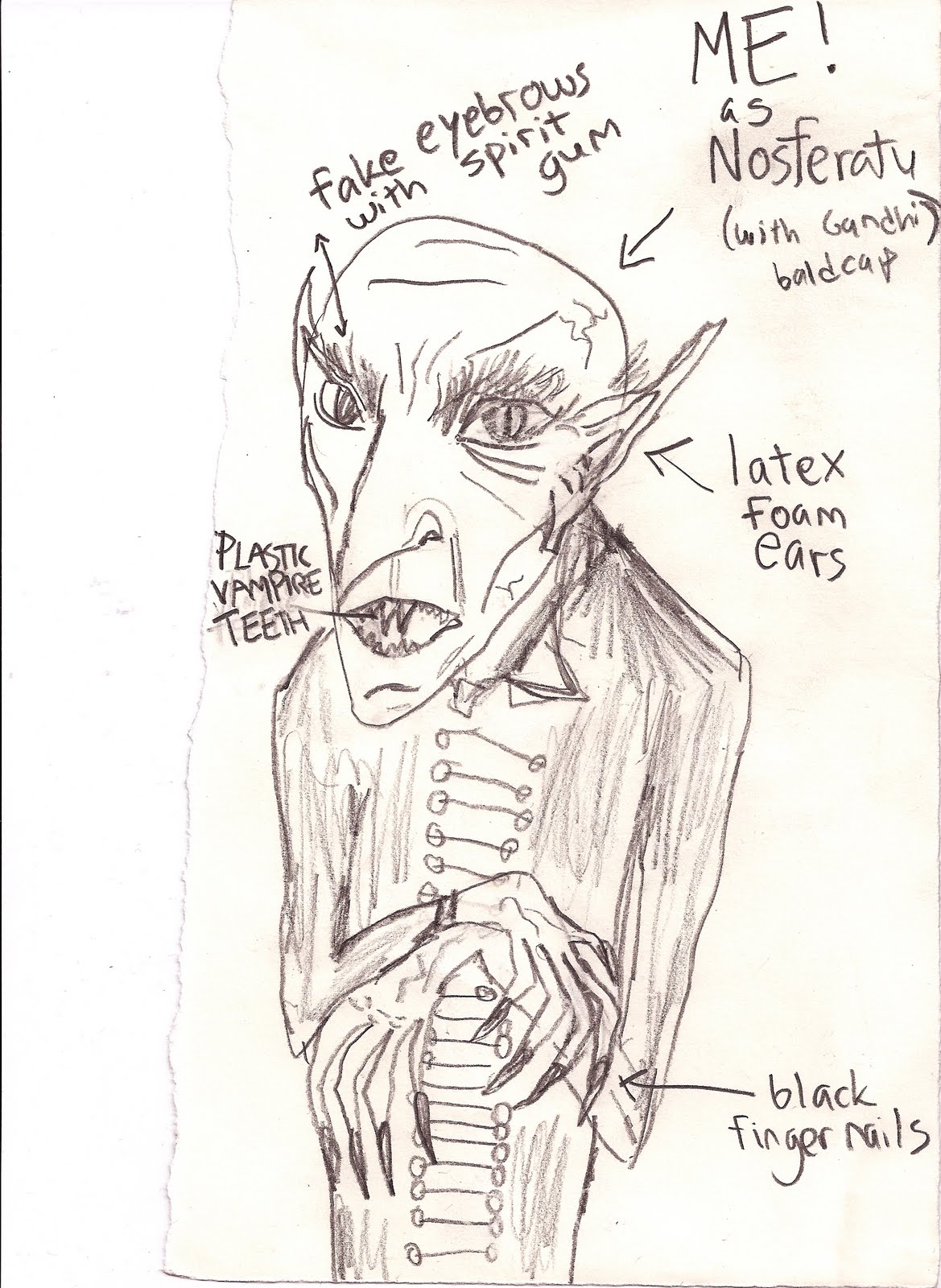
PS The following diagram is me as Nosteratu for Halloween. I didn't have the TAR FEELING for Halloween! I felt GREAT!!!!!!
By Flannery Lunsford


The author of six books, Kerry Madden is an assistant professor of Creative Writing at the University of Alabama in Birmingham. She is also the editor of PMS – PoemMemoirStory – also at UAB.  www.kerrymadden.com

Tuesday, August 31, 2010

Ready, Set …Wait! 10 Tips for Getting Published

by Annabelle Robertson

“How can I get an agent?”


That’s what every wannabe author wants to know – the question posed most frequently at book-signings, and the one readers always ask published authors about. It’s an important question. You can’t get a book published without an agent, after all. Not really. And landing one – a good one – is no easy task.

But, for the vast majority of hopeful writers, asking about an agent is a bit like a new flute player asking how to get an audition at Carnegie Hall. It’s just way too early to be worrying about that.

Years before my book, The Southern Girl’s Guide to Surviving the Newlywed Years: How to Stay Sane Once You’ve Caught Your Man, was published, I dreamed of being a writer. I had been the editor of my high school newspaper, and I longed to be a journalist. Because we moved to Europe when I was 18, however, I didn’t go to journalism school (that's kinda hard to do when you don't speak the language). But during college and graduate school, however, I wrote plenty of short stories and essays. The A’s and professorial praise were enough to fuel my dreams.

I wrote about what I knew, as I was told to do. I’d practiced international law in Switzerland, working for the United Nations and as corporate counsel for an American bank, so when I began my first novel, my main character was an American lawyer from the South, who just happened to living in Switzerland.

Of course, I never thought I was Pat Conroy or Rick Bragg. If anything, I was afraid to write, for fear that I wouldn’t live up to the awe-inspiring Conroy- and Bragg-level standards. But, deep down, I knew I could probably write a book and get it published, if only I worked hard enough. How hard could it be?

A lot harder than I imagined.

I began by reading about 50 books on the writing craft – everything from dialogue and plot books to tomes on theme, voice and characterization. I highlighted the pages of these books and did all the exercises. Then I bought more. I was determined to make up for what I hadn’t learned at the University of Geneva.

Next, I taped a sign above my desk that said, “Writers Write.” And then I wrote. Five nights a week, from 9 to 11 p.m., and all day Saturday, every Saturday, I slogged it out in our crappy walk-up duplex in Decatur, which had no central air-conditioning. Week in and week out, I worked on that novel. I even wrote on vacation. In fact, I took vacations, alone, just to work on my book.

Two years later, I called my husband into my home office as I typed those greatly anticipated words, “The End.”

I was thrilled. I figured I’d have an agent within a few months – a year at the most.

It took me five.

What I didn’t realize at the time (although I had been told many times) was that no matter how talented a writer may be, every first draft – from every writer – is bad. Usually very, very bad. And mine was no exception. Author Anne Lamott, in her book, Bird by Bird, which talks about the writing life, calls them “shitty first drafts.” And, as any good writer knows, first drafts truly are. But we don’t really get that until we’re established. We novice writers think our work is pretty darn good, and we don’t want to hear otherwise.

For some reason, we tend to wear blinders – big ones – when it comes to our work. “Talk to the hand! I know it’s good. My best friend said it was!” We want to get to center stage as fast as possible, and we tend to believe, rather naively, that writing is something that can be mastered easily and quickly. As Rita Mae Brown says, however, “It takes as long to learn writing skills as it does to become a neurosurgeon.”

This, I have learned, is an understatement.

I know just how disheartening this learning period can be for writers. After all, I was there myself, not that long ago. But consider this: Your book must compete with the 200,000 others published each year, of which a mere one percent sell more than 5,000 copies. A full 98 percent of all books published, in fact, sell less than 1,000 copies.

So, to be a success (a task that has become monumentally more difficult in the past two years), your book simply cannot be mediocre. It has to be phenomenal. Not only that, but when it comes to wowing an agent, you’ve got one shot, and one shot only. Do you really want to take yours now?

Perhaps you do. You’ve work-shopped that manuscript (or book proposal) to death. You’ve rewritten your book, again and again. You’ve put in the time, and you know you simply could not make it any better. It’s ready to go and it’s very, very good – or so say all the non-relatives and unpaid friends who’ve critiqued it.

Well, if that’s your case, darlin’, and you’re pretty sure you’re ready for the big time, then congratulations for gutting it out. I have no doubt that with a little perseverance, we’ll soon be reading your book – and you can stop reading here.

For everyone else, I invite you to pull up a chair and pour yourself some sweet tea. Sweet tea is good. But experience is better – much better. And if there’s anything we Southern Girls like to do, it’s share our experience and hand out advice – especially if we can save someone a little heartache.

Here’s my take, for what it’s worth, on what you really need to do produce the kind of manuscript that will wow an agent:

1. Read books about writing. You can get them online, from the library or a book club. I joined the Writer’s Digest Book Club and, thanks to their generous “buy four get one free” policy, now own a small library of writing books that I still refer to. These books were not only great fun to read; they also fueled my inspiration, giving me lots of ideas about characters, plots, themes and other literary devices. As I read them, I not only learned to write. I wrote my book in my head.

2. Read books in your genre. If it’s Southern fiction you love, read everything written by the authors on this site. They are phenomenal. Then move onto the bestseller lists. Examine these books just as an editor would, studying their structure, style, content and voice. Successful writers will not only give you fresh ideas; they’ll also improve your vocabulary and teach you how books work – everything from characterization and the all-important plot arc to inserting back-story and that illusive concept of “voice.”

3. Hang out with writers. Writing is a lonely discipline, and you’ll need likeminded people to encourage and teach you what’s what. Visit bookstores, where you’ll find future authors lurking in the coffee shop or in front of the reference shelves. Check out the local library or the classified ads section. Run an ad. Go to author readings. And don’t be afraid to talk to published writers. I used to do that, and I made friends with some of the very writers I now count as colleagues. They helped me tremendously, and it’s wonderful to see them zooming to the top of the bestseller lists, many years after just getting published. Now, when people approach me, I merely see it as “paying forward” all the help I’ve received.

4. Attend writer’s conferences. You’ll learn lots about the craft and the business of writing, as well as the all-important publishing industry. You’ll also meet published writers who may mentor you and perhaps even give you a quote for your book someday – which agents and editors love. Network. Listen. Take notes. And learn as much as you possibly can.

5. Find or create a writer’s group. My group, which I formed after we all met at a local writing conference, consisted of four other writers at different stages of their novels. They taught me things I could never have learned otherwise, and pointed out mistakes that I should have seen in my work, but didn’t. They encouraged me, supported me and gave me wonderful suggestions – especially when I got bogged down. Our weekly evenings spent laughing, dreaming and scheming are, to date, some of my happiest memories ever.

6. Have your writer’s group critique your entire manuscript. Then rewrite the book. You need their objectivity (and they need yours). Be especially sure to take their advice when they’re all in agreement.

7. Give your latest rewrite to at least three other people who are not afraid to tell you the truth. These volunteers should not be close friends or relatives, who will be tempted to equivocate – and who will unconsciously read your speaking voice into the manuscript. They must be objective. Have them edit it, line by line, and provide a written critique (if they will). If their advice is vague, ask probing questions like “What did you like best?” “What did you have trouble believing?” and “What would you change?” Make rewrites accordingly.

8. Be open to criticism - very, very open. After rewriting my novel no less than three times, a published novelist (now a 10-time New York Times bestselling author on this site) read my manuscript and loudly pronounced me a “future bestselling author” to anyone who would listen. I was thrilled. But, before I could bask in the praise, she brought me back down to earth with a few “suggestions.” Those suggestions required yet another rewrite of my novel. But I didn’t hesitate. I went straight back to the drawing board.

When my author friend heard that I was rewriting the book again, her jaw dropped. “Do you know how rare that is?” she said. “For a wannabe writer to accept that kind of critique? Much less put in the work?”

“No,” I replied. “I’m just doing what you told me to do. I figure you know what you’re talking about.”

She laughed. Then she said, “And THAT is why you’ll eventually be published, Annabelle.”

She was right. Nowadays, I’m a fulltime journalist, so I get edited every day, and the thought of rejecting those edits seems pretty strange, indeed. In fact, because of my career, I now know the difference between a good editor and a bad one. A good one improves my writing. A bad one says, “Way to go.” The problem is, the better your writing becomes, the harder these editors are to find. Yet we still need them – all of us.

So don’t fight the critiques. Embrace them. And remember that most people who read our writing have a huge investment in our feelings. When they give us feedback, they’re trying to be sensitive, so they usually couch things in roundabout ways. This means that when they do tell us something isn’t working, it probably isn’t. In fact, the problem they’re describing is probably much, much worse than they’re even willing to admit.

Writing is a business, and if you want a career in the field (as opposed to that hobby that takes up all of your free time, pays nothing and bores your friends to death), you will just need to accept that there are certain requirements to succeed. Remember, no one is asking you to change the color of your hair. They’re telling you what you need to do to succeed in the industry of your choice.

9. Make sure it’s finished – truly finished – before even talking to an agent. Don’t make the mistake of baiting a potential agent (like I did), only to be forced to confess that you haven’t finished the book (unlike non-fiction, which merely requires a proposal, you have to have your entire first novel completed). If an agent likes those first three chapters, she’ll ask for the rest. If you can’t immediately provide that, she’ll likely lose interest – which will be difficult to snag again. Even if you do a rush job and finish, you’ll still be submitting your first draft.

10. Persevere. There’s an old adage that asks, “What’s the difference between a published author and a non-published author?” Answer: “The published ones didn’t give up.” So don’t give up. It will take time for that first book to shine. Juist remember: writers not only write – they keep on writing.

I never did publish that novel, by the way. That’s right – the one I wrote and rewrote so many times. The one I sweated blood over, put my life on hold for, bored my friends and family to death over. Never published. Nope.

Instead, I wrote, got an agent for and was fortunate enough to watch as three publishing houses fought for the rights to publish my non-fiction book, in what's known as a "bidding auction". I can’t tell you how thankful I am that that novel never saw the light of day, however. In fact, my editor recently asked me to send it to her. I've been a little busy with a thing called "divorce," you see -- not to mention single parenting. So I haven't quite finished my next book.

Annabelle Robertson, in the newsroom of The Item in Sumter, SC -
where she gets edited every single day.


After much hesitation, I pulled out my old manuscript and read the first few pages. Without pausing, I tossed the entire thing into the trash. I didn't even keep a copy on my hard drive. It sucked that bad.
It's amazing what a little decade will do for your perspective.

Annabelle Robertson is an award-winning journalist based in Sumter, SC. Her first book, The Southern Girl’s Guide to Surviving the Newlywed Years: How to Stay Sane Once You’ve Caught Your Man, won the USA Best Books Award for humor in 2007. Annabelle has gone back to the drawing board and is working on her first novel. Again.

Sunday, August 29, 2010

SUDDENLY I'm Wordless

This is my first post during the transition phase of A Good Blog Is Hard To Find. Karin Gillespie did such an incredible job founding the blog, promoting it, collecting authors, and trying to herd us. Now she has passed on the herding to the Great Pulpwood Queen Kathy Patrick who has taken the helm so that the blog would not die and writers everywhere would be forced to go to the page and write something instead of just watch reruns of The Price is Right. Kathy's first request has been for each of us to introduce ourselves anew so that new writers and readers will discover us for the first time or the thousandth time with a tad more insight. Which has brought me to the point of staring at the page with an a Mick Jagger lyric echoing in my head. Just that one line over and over. What I'm thinking is everybody in the territory of this good blog knows me. And like most misfit children (*see destined to grow up and become writers in small print) I could still look out the window on a rainy day and say - No one really knows me. Or just get lost in though between the raindrops and pretty much not have words to say.

But I'm here now and it's my day - bless those blog ladies who enforce deadlines - so I must do what writers do, I better go dig some words up worth your time and mine.
Let me see - what's in this box of me right now . . .

Well, right on top are the words I wrote for my last post that generated comments but also a lot of private direct emails about some of the obstacles we overcome as writers. It's still right here if you'd like to backtrack and find out a whole lot of details about the 'stuff' I've endured on the path to publication.   And here's the thing - if you think the following about introducing myself again - or talking 'bout myself  - is a tad too much. Seriously, check out that obstacles post again. Years of drought, hard knocks, and whole lot of lamenting have gone into this thing we call The Writer's Life that can look so glorious sometimes from the outside looking in.

Next up - the only superstition I have in this whole, entire world is about talking about a story, a novel, a character, a piece of dialogue before it is written down or when it is in process. That comes from my days of being an understudy, an apprentice, a student - of Dr. Yolanda Reed of the Loblolly Theatre fame. Don't talk it - write it. That being said, I've had the strangest character show up in my mind. She's an old rascal and keeps asking me in a none too pleasant voice, "Now, what do you want?"  As if I'm the one intruding on her world. (That's also a nod to my good friend the great author Charles McNair who said writing was a lot like controlled schizophrenia.)  So this woman is in my mind and she's watching me. She has a tendency to do that sometimes with one eye closed. I have a funny feeling if I don't talk about her that she will tell me some things to write down. I'll keep you posted on that.

I have two new novels brewing and words from each actually down on the page. Okay, make that three but that 3rd one I think better sit back and peculate for awhile before moving closer to the top of the pile. I'm running my fingers through those worlds, one set in Georgia and one in Tennessee. Both in timeless times you couldn't swear a date to. I'm determined in the midst of all manner of life happenings to commit to one of those stories and begin the completion of that novel on September 1, 2010 in a few days. You won't hear much more from me about those stories until one of them is completed besides a potential working title. Except this - no, I don't have a contract for that novel. No, I'm not submitting portions and trying to sell it in advance. No, I don't have time to write something big and full of wonder. And yes, I'm wild and crazy enough to lock myself in a room for hours and do it anyway. It's what we do. We are story people. This is our tribe. We write.

Speaking of tribe - I have the pleasure of attending the SIBA convention in Daytona in September and also presenting with buddy author Shellie Rushing Tomlinson. If you're attending please don't get away or lost in the busy without connecting or saying hello. Then it's only a few weeks before the tribe will descend on my hometown of Nashville for the Southern Festival of the Book including Ms. Tomlinson and the Pulpwood Queen herself Kathy Patrick who will be hosting not one but two panels during he festival.

I have the grand pleasure of having a new novel debut on my youngest son's birthday (which wasn't planned) September 7, 2010. The Miracle of Mercy Land will debut on 9/7/10 at 7pm at Davis Kidd in Nashville. It's a southern, mystical work that catches our main character Mercy Land in 1938 on the southern coast of Alabama. For a sneak peek at the first chapter check it out here.  I do so hope that you can join me for a little storytelling and a lot of fun if you are in the neighborhood. SNEAK PEEK


In other news a new non-fiction work, Praying for Strangers, An Adventure of the Human Spirit, will be published by Penguin/Berkley April 5, 2011. It's based on a resolution I had in 2009 to pray for a stranger each day. Funny thing was, it was a private issue and I never meant to tell anyone and I certainly never meant for it to turn into something public like a book or you can check out the blog and comments regarding the ongoing adventure at http://prayingforstrangers.com It really has been an adventure and the stories of the people I met along the way, and the experience of that journey is captured in the stories told. Please visit the website/blog and check in as the project develops a life of it's own.

One of my special labors of love is hosting and producing Clearstory Radio every Friday morning (soon moving to a daily morning slot) from Nashville at 107.1fm  The show features author chats, bits of book news and reviews along with fun musical interludes. (And if you'd like to be on the show please email me at river@clearstoryradio.com ) I've had the pleasure of featuring many of the contributors to A Good Blog Is Hard to Find, and recently featured a special salute to the blog and all that it has accomplished. To the past! To the future! To the now! Also - for those of you who have made it this far - if you know anyone really interested in writing and getting published please click the radio link to listen to last weeks program featuring an interview with author Michael Lister. I love the sage advice this man had to offer to those who dare to dream of having this wonderful, messy, mixed up life we call writing.

Oh - since this is a get to know me better blog post I think the best way you can know someone is by the company they keep and by that I mean what books they are hanging out with. This my real beside table. A strange collection of newly published books by friends, ARC's for review, recommended reads, small discoveries, recent buys and the ever faithful library last minute snatches - : The Improper Life of Bezilla Grove by Susan Greg Gilmore and The Immortals by J.T. Ellison. (Here's a photo where we converged on Susan's signings at DK) Mystics, Visionaries, & Prophets; The Wisdom of Donkeys (a delightful fun find); Counter Clockwise; Wisdom of the Benedictine Elders; Moving Toward Balance;  The Angel's Game; Cutting for Stone; rereading Carson McCullers, The Member of the Wedding and wading happily through the Sunday NY Times.

God bless you all. It's an honor to be in your company!

River


RIVER JORDAN is a critically acclaimed author, as she keeps telling her Mama who responds by saying 'Show me the Money'. She has managed to publish four novels by the grace of God, her husband's hard work and a touch of madness. She will begin  to complete a new novel Wednesday. She also may respond to an itch to return to the theater to sit quietly in the dark and watch the magic of words come to life on the stage. She still maintains her strange resolution to Pray for a Stranger each day except on Sundays when she takes a day off to rest and give thanks. And oh yes - to read.