Tuesday, July 5, 2011

Staying on Top of Things

By Man Martin

People ask me all the time how I manage to get so much done.  It's simple, I reply; you have to have a rigid system and stick to it like velcro, once you've got that, everything else comes easy.
My system involves leaving everything lying around in the open wherever I happen to drop it.  This takes iron self-discipline and not everyone can do it.  My wife, for example, is constantly giving into the temptation to file things, to tidy up.  Moreover, as much as I hate to castigate her in a public forum, she often tries tempting me to do the same.  "Why the hell don't you straighten up your damn desk once in a while?" is how she phrases these temptations, but as alluring as her offers are, I resist.  Just say no is my motto.
If you ask her about her little habit, she'll say she can take it or leave it alone, but the truth is she's a compulsive tidier.  She can't help herself.  I've given up trying to reform her, but I refuse to be her enabler.
My system offers several obvious advantages.  To start with, all the time saved on filing and tidying can be put to use drinking writing.  Moreover, after a long day of drinking writing, when my head falls to the desk in a stupor exhaustion, all the piles of papers and unpaid bills make a nice fluffy pillow to land on.
Best of all, no matter where I look, I'm bound to find some critical piece of something I thought I'd mislaid.  Often, when coming-to after my mid-afternoon siesta, I find a much-needed piece of paper stuck to my forehead.  And bill collectors are a good deal less demanding when they know their "please remit" statements have been drooled over, I can tell you.
Again, consistency is the essence of the system.  I cannot stress this enough.  Once you put the first thing away, you've had it.  "Oh, it won't matter if I file this one little thing," people tell themselves, or "Maybe I should throw away some of this useless crap just once.  What could it hurt?"  But that path leads to madness.  Better just to leave things where God and gravity demand.  If you have a system, as I do, don't vary it, not in the slightest.  It's like with martinis: first mix the gin and vermouth together in a shaker, then drink it.  You might think it would work just as well to drink a shot of each then jump up and down, but that'll just give you a headache.  It's the same way with filing.
And who needs that headache?

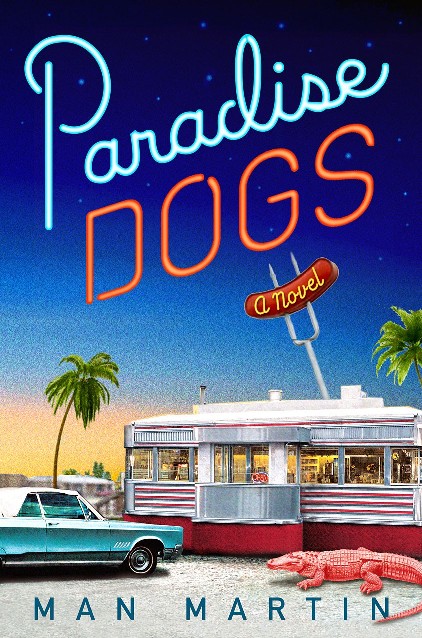
Man Martin is the author of Paradise Dogs, which The New York Post calls "required reading" and Booklist says is "simply brilliant."  Now you can win your own autographed copy by visting http://manmartin.blogspot.com and entering the STOOPID Contest.

Thursday, June 23, 2011

Introducing C. Richard Cotton......by Peggy Webb

I am often asked to mentor someone who is writing a first book.  My schedule of writing, traveling, promoting leaves me very little breathing room, so I usually say no. If I didn’t, my children and grandchildren would probably stop speaking to me. They live in far-flung places – Florida and New Hampshire – and I do enjoy loading my Jeep for a jaunt across Mississippi, Alabama and into the Panhandle, or hopping a plane bound northward.  

But when my friend, C. Richard Cotton, told me he was going to write a book and needed some guidance, I was elated and jumped at the chance to mentor. He’s a very fine free lance journalist, and I knew he had the talent and the discipline to succeed.

We chatted about where to start his story and the novel writing process in general, and he set to work. When he sent the first two chapters, I knew that Richard needed nothing from me but encouragement.  “Keep going,” I told him. “And don’t stop until you finish.”

The result is an incredible non-fiction novella - Then Came Cancer: A Love Story.   I can’t find enough accolades to do this book justice. I read it in one sitting. I cried and laughed, then cried some more. And when it was over, I not only applauded Terri Cotton’s courage and humor as she fought a five-year losing battle with a rare form of cancer, but I was awestruck by Richard, who turned his deep love for his wife into an amazing memorial.

This is the quote I wrote for him:
 
"Then Came Cancer: A Love Story is the chronicle of battling cancer, of a marriage, of love. But most of all, it's unforgettable! Writing with a raw honesty that is his hallmark and a journalist's eye for detail, C. Richard Cotton also brings a loving husband's heart to the page. He tempers heartbreak with humor, horror with hope, loss with love. The result is a beautiful, powerful story, a Must Read!"
                          Anna Michaels, author of The Tender Mercy of Roses

Richard’s book will soon be available (probably by the first or second week in July) as an e-book… and eventually, a print on demand. I don’t have a specific date, but do keep an eye out. You don’t want to miss this book!

On a personal note, I’m happy to announce that I’m bringing my romance classics back as e-books!  Originally published under the Loveswept imprint at Bantam, these are timeless love stories with some great retro moments.  “He’s a hunk like Tom Selleck.”  Remember the days of Magnum P.I., Back to the Future, “Endless Love” by Lionel Richie and Diana Ross?

Five titles are available now – Duplicity, The Edge of Paradise, Touched by Angels, A Prince for Jenny, and Dark Fire. Three are coming out next month and many more are on the way!   Check out the great new covers!

Peggy Webb lives in Mississippi where her gardens are wilting in the heat and she stays holed up in her air-conditioned office with her muse. (You thought she was going to say a handsome hero, didn’t you?) She writes literary fiction as Anna Michaels and everything else, including the Southern Cousins Mystery Series, as Peggy. Currently, she’s having fun editing her romance classics and falling in love with her Loveswept heroes all over again. 


Wednesday, June 22, 2011

Father's Day (Or How My Father Was Like Stephen King)

By Andy Straka

I’ve loved reading all the posts this month about “Living with a Creative Lunatic.”  From the poignant to the hilarious.   There must be something cathartic about coming clean regarding our selfish eccentricities and at times downright strange behavior as writers.

This past Sunday was Father’s Day.  My wife and kids spoiled me with a pile of handmade cards, a new basketball hoop, and a new coffee mug (pictured). I didn’t get any writing done, but I had a fantastic day, and it got me to thinking.  

To me every day is Father’s Day. No, really.  What more can a father ask for than to be surrounded by his family each day and still be able to pursue the work that he enjoys?

It takes a superhero wife and special children to put up with a husband and father who manages to mysteriously disappear for long stretches of time to pound away on his computer.  It takes mountains of paper, gallons of hot liquids, bottled water, and diet soda, and mega-quadruple miga-gigabytes of computer power.  It takes being awakened in the middle of the night by someone clumping down the stairs or dropping exhausted into bed only to fall instantly asleep.  It takes putting up with forgotten phone messages, yard work left undone, books and papers and other paraphernalia left piled around the house.  It also takes the patience of Job to listen to someone constantly scheming about new characters, titles, and story ideas while pursuing a craft that leads to uncertain financial rewards.  

Despite all of the above and more, my wife somehow continues to love me. She has even cobbled together an inventive yet stable family, where storytellers like her husband aren’t seen as alien creatures sprouting mutant heads and toes.  Will any of our six children eventually become creative lunatics like their old man?

The folks over at AbeBooks have compiled a fascinating list of father/son writers that may shed a little light.  Pretty amazing when you read about the likes of Alexandre Dumas, H.G. Wells, and even Stephen King and his son Joe Hill (a/k/a Joseph Hillstrom King).

Andrew H. Straka
My father may not have been a writer or achieved as much as Stephen King, but I’m sure, like Joe Hill, I caught the creative lunatic bug, at least in part, from my Dad.  Andrew H. Straka was an engineering genius who built his own company from the ground up.  One of the first manufacturers to get into plastics (Remember that quote from the movie The Graduate about plastics?), he often seemed to have this impish grin on his face because he, too, loved the creative process.  He also loved flight and once purchased a single seat, mini-helicopter kit including detailed plans for building his own personal airship, before my mother talked him out of the idea.  My father’s untimely death left our family with a gaping emotional hole and not much in the way of material wealth, but his creative spirit was his everlasting gift to me. So here's a heavenly salute to you, Dad.

Maybe this creative lunatic thing is genetic after all.  Or maybe it’s contagious. Maybe there’s a little creative lunatic in us all.

I don’t know what each of my children will wind up doing, but I can almost hear two of the older ones talking now.

“Where’s Dad?”

“Off writing again.”

Just as it should be—at least until it’s time to come read stories and be Big Daddy.

Happy Father’s Day.  Again.
______________________________


Publisher's Weekly has featured Andy Straka as one of a new crop of "rising stars in crime fiction." His books include A WITNESS ABOVE (Anthony, Agatha, and Shamus Award finalist), A KILLING SKY (Anthony Award Finalist), COLD QUARRY (Shamus Award Winner), KITTY HITTER (called a "great read" by Library Journal), RECORD OF WRONGS (hailed by Mystery Scene magazine as "a first-rate thriller"), FLIGHTFALL (a soon-to-be-released novella), and a new thriller, THE BLUE HALLELUJAH, coming later this summer.

Andy has worked as a book editor, movie production accommodation agent, commercial building owner and consulting vice president for a large specialty physician’s practice, surgical implant and pharmaceutical sales representative, college textbook sales and manuscript acquisition representative, web offset press paper jogger, laborer on a city road crew, summer recreation youth director, camp counselor, youth basketball coach, assistant parts manager at an auto dealership, assistant manager at a McDonalds restaurant, and even been registered as a private investigator. (Not to mention a longstanding stint as a stay-at-home Dad to six, which makes neurosurgery look like tiddlywinks.)  
Also a licensed falconer and co-founder of the popular Crime Wave at the annual Virginia Festival of the Book, Andy is a native of upstate New York and a graduate of Williams College where, as co-captain of the basketball team, he "double-majored" in English and the crossover dribble.  He lives with his family in Virginia. Follow him on Twitter and Facebook.


Tuesday, June 21, 2011

Living With a Writer’s Brokenness


by Susan Cushman

I recently read The Paris Wife  by Paula McLain. It’s a novel about Ernest Hemingway’s first marriage, to Hadley Richardson, written through her voice. I thought I’d share some of it as part of my post here on what it’s like to be married to a writer. (NOTE: I wrote this before I read Karen Harrington's post, but at least we're giving a bit of a different take on the book.)

Ernest and Hadley were married during the time he lived in Paris and wrote The Sun Also Rises, which fictionalizes quite a bit of their hard-drinking fast-living life with a colorful circle of friends in Paris. It was Hadley’s lot to be his wife during his early years of struggling to find his voice as a writer, as she struggled to hold onto herself as a woman while being his wife and muse. This sentence shows some of Hadley’s struggle:

“I close my eyes and lean into Ernest, smelling bourbon and soap, tobacco and damp cotton—and everything about this moment is so sharp and lovely, I do something completely out of character and just let myself have it.”

Why was it out of character for Hadley to let herself have that lovely and intimate moment with him? I think she took her role as muse and supporter to a brilliant artist more seriously than her role as his lover and wife, so she devalued herself as a person. McLain creates lots of dialogue that shows this aspect of their relationship:

“I’m not sure I get it completely, but I can tell you’re a writer. Whatever that thing is, you have it.” (Hadley)

“God that’s good to hear. Sometimes I think all I really need is one person telling me that I’m not knocking my fool head against the bricks. That I have a shot at it.” (Ernest)

And then she shows the complexity of their relationship through interior monologue: (Hadley thinking)

… it struck me how comfortable I felt with him, as if we were old friends or had already done this many times over, him handing me pages with his heart on his sleeve—he couldn’t pretend this work didn’t mean everything to him—me reading his words, quietly amazed by what he could do. . . .

And the limitations that Ernest’s work put on the marriage: (again through Hadley’s thoughts)

Hadn’t I just felt us collapsing into one another, until there was no difference between us? It would be the hardest lesson of my marriage, discovering the flaw in this thinking. I couldn’t reach into every part of Ernest and he didn’t want me to. He needed me to make him feel safe and backed up, yes, the same way I needed him. But he also liked that he could disappear into his work, away from me. And return when he wanted to.

I have to get away from my home, and from my husband (whom I love) in order to get serious amounts of writing done, which is why I spent the month of November writing at the beach. And sometimes I just need hours of quiet to think, before ever putting words on the page. I found it interesting that Hemingway also felt that way, and Hadley wished he wouldn’t leave:

“It’s been so long since you’ve even tried to write here at home. Maybe it would work now and I could see you. I wouldn’t have to talk or disturb you.” (Hadley)

“You know I need to go away to make anything happen…. I have to be alone to get it started….” (Ernest)

A couple of weeks ago I went to the Yoknapatawpha Summer Writers Workshop in Oxford, Mississippi. One night the workshop leader, Scott Morris, gave his annual craft talk, this time on “Voice.” (Read more about the workshop and Scott’s talk here.) One thing that stuck with me long after his talk was what he said about the writer’s cross—that we will always be reaching for something just beyond our grasp, using words to make sense of the world and to make peace with our suffering:

“The novel will just sit down in that place of suffering and spend time there…. The great novel trades in regret…. This type of writing is up against the dominant culture of the day…. Great writing is about going to those wounds and staying there.”

This reminded me of something Hadley thought about Ernest lately in the novel:

It gave me a sharp kind of sadness to think that no matter how much I loved him and tried to put him back together again, he might stay broken forever…. He wanted everything there was to have and more than that.

We are all broken creatures, but I think that artists and writers carry our brokenness in a more intense manner. It’s hard on our families. Although my husband is also a writer, he’s a physician and his writing is scientific. He has no problem writing an article for the New England Journal of Medicine while I’m in the room with him (and a football game is on television and he’s checking email on his Blackberry). But I need physical and emotional space in order to create words on the page, and he gets that. Our kids have been out of the house for ten years now, and we celebrated our 41st wedding anniversary on June 13, so he’s been living with my brokenness for quite some time.  But unlike Hadley and Ernest, we’re not "collapsing into one another." We’re two fully realized persons who don’t need the other person to complete us. Instead, we are learning to be supportive of each other’s careers, which we are both passionate about.  Hopefully we’ve dodged the bullet that destroyed Ernest and Hadley’s marriage, which McLain describes in the Epilogue of the book, thirty-five years after their divorce, when they are both married to other people:

“Tell me, do you think we wanted too much from each other? . . . . Maybe that’s it. We were too hooked into each other. We loved each other too much.” (Ernest)

“Can you love someone too much?” (Hadley)

He was quite for a moment. “No,” he finally said, his voice very soft and sober. “That’s not it at all. I ruined it.”


Susan Cushman has nine published essays, one novel and two memoirs tucked safely away in a drawer, and a novel-in-progress that she hopes to publish one day. Later this year, her essay, “Chiaroscuro: Shimmer and Shadow,” will appear in the second volume of the anthology, All Out of Faith: Southern Women on Spirituality, from the University of Alabama Press. She is a guest blogger on Jane Friedman's Writers' Digest blog, "There Are No Rules," and her personal blog is "Pen and Palette." Susan is director of the 2011 Memphis Creative Nonfiction Workshop coming up in September. (Registration is open and spaces are filling quickly!)

Monday, June 20, 2011

Dedicated To The One I Love

by Karen Harrington

I just finished reading The Paris Wife by Paula McLane. This is must-read material for writers and their spouses. The story follows a fictionalized account of Ernest Hemingway’s courtship and first marriage to Hadley Richardson in the early 1920s. The novel, which was drawn largely from letters exchanged between Hadley and Hemingway before he gained fame,­ is told through Hadley’s eyes with a few chapters dedicated to Hemingway’s point of view. The reader gets an up close look at her role as supportive friend and spouse to an aspiring writer. I was riveted by the ups and downs Hadley experienced. So often, she felt like an outsider, excluded from her husband’s writing life. (He even rented a tiny office and left each day to write.) Other times, Hadley felt certain she was playing a supportive role in birthing Hemingway’s career. We’ll never know if his early career would have flourished without her, but she was certainly remarkable in her support. Not every spouse would have been as long-suffering and encouraging as Hadley.

In my case, I might have the closest thing to the kind of support Hadley offered – only in male form. Sure, my husband wouldn’t be keen on my going and renting another room to write or moving to Paris just so I could soak up the atmosphere. But here’s what he has done for this writer’s life:

-         Arranged our lives so I could be a stay-at-home mom/writer – which is my dream job!
-         He frequently takes the kids out all day so I can have the house to myself to write.
-         Each November when I take on the National Novel Writing Month (NaNoWriMo) challenge, he slides coffee and cinnamon rolls into my office.
-         He tolerates notebooks all over the house
-         He lets me chatter on about plot twists and problems and character names
-         Encourages the purchase of turtle-necks which he calls “writer wear”
-         Tells all his friends about my book, often bringing me a few copies to sign for his colleagues

If he’s had an influence in my writing, it’s when he challenges my subject matter. He’s often said, “Why are you writing THAT?” My first attempt at a novel was about a Viet Nam vet returning home. “What do you know about that? Why Viet Nam?” Because it interests me, I replied.

Around the time I had my first child, I began writing sketches for what would become JANEOLOGY. The genesis of this story was my curiosity about mothers who kill like Andrea Yates and Susan Smith. I wanted to know everything about their backgrounds; how they were raised; and, did anyone suspect or see anything in their behavior that might predict their infamy? One day, a package was delivered that included the books Mothers Who Kill Their Children: Understanding the Acts of Moms from Susan Smith to the "Prom Mom"  and Where Is Baby’s Belly Button?

My husband jokingly remarked, “Just so you know, whoever packed your order at Amazon is wondering if they should have someone check on you.”

He will tell you that at first he thought I was weird to choose infanticide as a subject while I was new to motherhood. Later, he realized that it was my protective instincts as a new mother that drove me to the story. I don’t know that I could have written it so forcefully without that fuel.

Lately, I’ve written about a fanatical cult in Texas and one family at the center of it. (You should see the books from Amazon now!)

He shakes his head as if to say, There she goes again.

Thanks, Hubby. You make a huge difference in this writer’s life! This post is dedicated to you.

-- 

Karen Harrington is the author of Janeology. You can visit her at http://www.karenharringtonbooks.com 


Sunday, June 19, 2011

By the Light of the Moon


 By Augusta Scattergood

Last week when the full moon lit up my patio, the ancient moon goddess Luna came to mind. This morning I’m pondering whether or not I fall into the category of lunatic writer. 

I think not. 

But each of us has a bit of madness swirling through our writing habits. There’s no escaping it.

Before I became a writer, I was a reader. My tastes ranged from mysteries to histories, from picture books to coffee table art books. But did ever I stop to think how those books came to be created? And if I did, did I think—that writer is engaged in extreme foolishness.

That changed a while ago, when I fell in love with the books of a Baltimore writer
She rarely spoke about her process publicly, but she lived right up the street. We shared a mailman. His name was Ollie.  We occasionally shared a bench in the Quaker Meeting we both attended. She didn’t know me, and I didn’t dare speak to her.

I read everything she wrote yet never questioned how she created those amazing novels depicting my Baltimore neighborhood so precisely.  Then Ollie our mailman appeared in her new novel, and I began to think about how fiction springs from reality. She described Ollie exactly as I saw him each day walking the two blocks from her house to mine. He had suffered a death in his family and was sadder and sadder each time I greeted him at my front door.

 In another novel, she described a member of our Meeting who could no longer speak but scribbled notes and handed them to the person next to him to read. I knew that person! There he was, along with Ollie the mailman, in her books.

And it hit me. That’s what writers do. They remember mailmen. They know the cashier at Walmart and imagine how spent her morning before reporting to work. Writers scribble notes. They see real people and create backstories. With a little--or a lot of-- tinkering, they turn real people into book characters.

And that's what I wanted to do. Remember funny things and turn them into stories. 
Maybe that makes writers crazy people, lunatics, even without a full moon.

Yes, I love the Notes feature on my phone and I have a ton of notebooks small enough to fit into a pocket, but the number of character sketches I write on boarding passes and sales receipts and napkins is sheer madness.

Just a quick look through my file folder of scribbles found these from long ago, or maybe from yesterday. No clue what most of them mean, but if a non-writer found them, lunacy might be deduced.

She got a Pink Princess telephone. Birthday gift.

Old man at South of the Border: "That dog's got some age on him." (About my sweet old lab Barley. I've already used this one.)

I got ahold of some bad ice. (Guy stretched out on a couch.)

Daddy took a candelabra to the Outback Steakhouse.

One of my favorite back-of-a-boarding-pass descriptions is of a young woman in the Atlanta airport. She was (I’m convinced) meeting her boyfriend after a long flight. She had time to spare. She had dipped her head under the ladies' room sink’s water and was now sitting on the floor drying her hair under the hot air of the hand dryer. Soon she began to cry. Tears of happiness or misery?

Now you know you want to hear the rest of her story, don’t you?

So the full moon was up there again last week, and I wondered about madness and folly. I wondered how many moms in labor were lined up outside the delivery room. I wondered how many crazies were out there howling. And how many writers were awake scribbling notes, inventing characters, and just plain making up crazy stuff by the light of a big bright moon smiling on the night.

Augusta Scattergood mostly writes during daylight hours, on a computer. But her files are full of old grocery lists, receipts, bookmarks, tiny notebooks. Her weirdest notes usually, eventually, make complete sense to her. Click on over to her own blog sometime: http://ascattergood.blogspot.com/

Just curious now- Anybody out there taking notes on something other than your iPhones these days? Writing something that makes sense to you and you alone?


Saturday, June 18, 2011

Living with Me by Niles Reddick


When I read the topic this month, I thought it would be an easy one to write about. Certainly, I thought, living with me has been a cakewalk for my wife Michelle, especially after having been married to me for almost twenty years, but then I had to back pedal. I wondered. Was it? What did she really think about living with a writer?  I also wondered what my two children Audrey (age 8) and Nicholas (age 5) thought, if they even really understood.  So, I asked them, and I was surprised by their responses.
When I asked my daughter Audrey what it was like to have a dad who is a writer, she said, “It’s boring. You stay on the computer all the time and type, but you are kind of fun to play with. It’s always good when you help me with my writing for school.” My son Nicholas, on the other hand, didn’t have a lot to say, shrugged and said “Uh…uh,” or something like that, which translated means, “I don’t know.” Nicholas and I have had conversations about his responses before he starts kindergarten this year, but so far, his changing those responses hasn’t stuck.
Michelle, though, had a great deal to add. She asked if I wanted the negative or positive first. I was surprised there would be any negative. She started, “I feel like a single mom sometimes. Between your job and then coming home and writing on the computer, you’re not as involved as you could be. When’s the last time you started baths for the kids?” I didn’t remember, but it hadn’t been that long and besides, they are old enough to be able to run their own baths. I imagine them dysfunctional adults unable to run a bath.  She also told me she hated me eating at the computer, getting crumbs stuck in the keyboard and smashed onto the floor. I know that I sometimes snack at the computer, but I do try to clean up after myself. She also hates being grammatically corrected, but she admits that I don’t do that as much anymore. Of course, what she doesn’t know is that I think her whole family has some sort of undiagnosed word disorder and the correcting doesn’t do any good anyway.  One time her dad was riding with us through a neighborhood where he lives. We were looking at homes and he told me to turn around in the “cow-de-sac.” I honestly didn’t know what he meant, but it finally dawned on me he meant cul-de-sac.  I didn’t bother to correct him either.
Then, she changed her tune to the positive. She told me she has enjoyed the hundreds of good books on the shelves and laying all over the house to read (not mine, mind you), and she enjoys hearing stories, “multiple times,” she adds (hinting at my reading them aloud as I edit over and over and over).  She also tells me she enjoys going to the festivals and conferences, so she can meet other writers.  Recently, we were in the foothills of North Georgia in Canton, where Terry Kay (author of To Dance with the White Dog, among many other books) did a presentation after the panel discussion on which I had participated. I’ll admit that I got a bit of a rush from meeting him, seeing him in the audience, listening and even laughing a time or two. I have all of Terry’s books, and now Michelle is reading them and loving them (more than mine even though she won’t admit it. If I wanted to ask her to compare, she’d just say, “They are just different from yours.”).  Incidentally, both of my children absolutely hated going to the festival. They were hot, tired, and hungry, and they hated being dragged over to the outlet mall in Dawsonville after the festival to hunt deals.
When folks come up to Michelle (she’s the extrovert in the relationship) and mention my writing, she thinks it’s “cool” and enjoys talking with others about my books.  If she could change something, though, Michelle wishes I could devote more time to writing. I must admit that some days I would agree with her, but I do think if I had to write full time, it might be extremely difficult for me to do so.  Writing also wouldn’t pay the electric bill, let alone the house payment, cable bill, cell phone bill, water and sewer bill, buy groceries, make the car payment, and let’s not forget the buying all the books I need to read. 
Niles, Michelle, Audrey and Nicholas on the Right. The Inman Majors family on the Left. Inman is author of three novels: The Millionaires, Wonderdog, and Swimming in Sky. This photo was taken at the Majors' home in Virginia on last year's summer vacation. This year, we are off to the mountains of North Carolina and a trip to the beach.
 Niles Reddick is author of a collection of Road Kill Art and Other Oddities, which was a finalist for an Eppie award, and a novel Lead Me Home, which is a finalist for a ForeWord Award and was a finalist for first novel in the Georgia Author of the Year Awards.  He is author of numerous short stories in journals and anthologies. The Reddick's live in Tifton, Georgia, where Niles works for Abraham Baldwin Agricultural College. His website is www.nilesreddick.com