Monday, November 7, 2011
Road Writer
I've had many jobs, but probably the one that has most informed my writing was working as a sales representative.
From publisher's rep (college textbooks) to medical sales (pharmaceuticals then orthopedic implants, then medical imaging and neurodiagnostic equipment), my road warrior years gave me a street level view of multiple worlds. Big cities and small towns and everything in between. From New York City to Connecticut and Massachusetts; from Washington, D.C. to Richmond, Charlottesville and Virginia Beach, North Carolina, and West Virginia.
My novels are all set in one of these locales. And even years later, in the era of GoogleMaps, I can close my eyes and picture the sights and sounds and smells of a neighborhood in the Bronx or Richmond's West end, the tony suburbs of Greenwich, CT, a winding switchback highway in the West Virginia mountains, or a beach town on the North Carolina coast. The inside of hospital operating rooms, corporate boardrooms, military bases, fly-by-night trade schools in Brooklyn—any one of these may come to mind when I write fiction.
My writing career was born on the road as well. In lonely hotel rooms at night, where I began to bang out stories and the first draft of a novel.
I've long since given up the sales life and escaped to the woods, or at least my little piece of the woods where I am blessed to be with my family, fly my hawk, and write. I’ve also had the good fortune to travel to many other places, including China, Mexico, and South America, and maybe I’ll be writing about some of those places one day as well.
The beauty of books is they can allow us to experience places we might otherwise never have the opportunity to see. Where have you traveled, and what sights and sounds and smells of different places have you experienced in your own life? How have these memories shaped you as a reader or a writer?
---------------------------------------------------------------
Publisher’s Weekly has featured Andy Straka as one of a new crop of “rising stars in crime fiction.” His books include A WITNESS ABOVE (Anthony, Agatha, and Shamus Award finalist), A KILLING SKY (Anthony Award Finalist), COLD QUARRY (Shamus Award Winner), KITTY HITTER (called a “great read” by Library Journal), and RECORD OF WRONGS, hailed by Mystery Scene magazine as “a first-rate thriller.” FLIGHTFALL, a Frank Pavlicek novella, was published as an ebook in August. His latest book is THE BLUE HALLELUJAH a novel of suspense, just released in trade paperback and ebook.
Andy has worked as a book editor, movie production accommodation agent, commercial building owner and consulting vice president for a large specialty physician’s practice, surgical implant and pharmaceutical sales representative, college textbook sales and manuscript acquisition representative, web offset press paper jogger, laborer on a city road crew, summer recreation youth director, camp counselor, youth basketball coach, assistant parts manager at an auto dealership, assistant manager at a McDonalds restaurant, and even been registered as a private investigator. (Not to mention a longstanding stint as a stay-at-home Dad to six, which makes neurosurgery look like tiddlywinks.) A licensed falconer and co-founder of the popular Crime Wave at the annual Virginia Festival of the Book, Andy is a native of upstate New York and a graduate of Williams College where, as co-captain of the basketball team, he “double-majored” in English and the crossover dribble. He lives with his family in Virginia.
Learn more at Andy's website/blog "The Hawk Writer's Guide To The Galaxy" at www.andystraka.com
Monday, November 15, 2010
My Best Friends are All Adventurers
by Patricia Sprinkle
My friend Miriam once confided, "I always wanted to be an adventurer."
She and I recently returned from a five-week trip to India and Nepal. She wrote me a note afterward: "Thanks for the adventure of a lifetime." It was. The real purpose of our trip was to teach creative writing for three weeks to middle school students in a small village school, but we can also check "Ride an elephant," "Visit the Taj Mahal," and "See the Himalayas" off our bucket lists.
Only recently have I begun to appreciate how brave we were. We went alone and made our own travel arrangements, staying in moderately priced hotels and hiring our own guides. Everything went exactly as planned except when our train from Agra to Delhi took us to a station across the city from our hotel. We will never forget our late-night ride through Delhi traffic in an auto-rickshaw, also known as a tuk-tuk. Most of the tuk-tuks we saw had some religious talisman swinging from the mirror or painted on the front. We know why. Riding a tuk-tuk through India's traffic does wonders for your prayer life.
If people who read are adventurers at heart, that goes double for writers of fiction. We inhabit two worlds most of the time--the mundane world our bodies move around in and the far-more-exiting world our characters know. No reader enjoys an adventure in a book that the author hasn't already experienced, revisited, and honed down to its bare bones.
Maybe that's why the authors I know are so enjoyable to be around. Every one of them is as interesting as the people s/he writes about. While the mystery writers don't generally go around killing people, the romance writers are seldom involved in torrid affairs, and the southern novelists don't spend their entire days drinking mint juleps and coming up with cute new expressions, they are all curious about life and aware that there are more things under the sun than any of us will ever comprehend. As the late Charlotte MacLeod once said, "Don't write what you know, write what you want to know." Anybody who meets Charlotte's quirky characters will be astonished at how many things Charlotte wanted to know.
So let's lift a glass to readers and writers, people who know that life is short and ought to be lived to the fullest. As a note says on the bulletin board above my desk, "Life should not be a journey to the grave with the intention of arriving safely in a pretty and well-preserved body, but rather let's skid in broadside, thoroughly used up, total worn out and loudly proclaiming, 'Wow! What a ride!'"
If your own life gets too dull, let me recommend a ride in Indian tuk-tuk.
Patricia Sprinkle is the author of twenty mysteries and three novels. Her most recent novel is Hold Up the Sky. A fourth, Friday's Daughter, will be released in March.
Monday, January 18, 2010
The Future of Publishing as I See It

As I pull up a stark white canvas to take my humble turn at Karin’s wonderful blog, fresh off the road from Kathy Patrick's delightfully wild Pulpwood Festival in Jefferson, Texas, it occurs to me that there’s no topic I’d like to address more right now than the future of publishing. (Note to reader, I’m not so sure I’ve taken my writing to the next level, so we may not go there. Only the muse knows. And may I add in a shameless attempt to hold your attention, that Pulpwood Pics of this most unique festival shall be forthcoming later in this post. )
Ironically, this very question concerning our industry’s future was put to an author panel I shared this past weekend with River Jordan and Deeanne Gist. My fellow panelists took turns speaking eloquently to the topic and then it was my bat. Because I somehow doubt the audience was riveted by my contribution, I’m choosing to consider this my do-over opportunity.
A world without books, could it really be? I can’t remember a day when the feel of a new book between my hands didn’t make my heart skip. I do remember being perched in a treetop scanning a long country road for the parish bookmobile. I can’t remember what life was like before letters made words and words made sentences. I do remember pushing open the bookmobile door and stepping my bare-footed self into my version of Disneyland. Book Land, books high, books low, darn that limit, anyway! How was a girl to choose from the treasures?
No, I can’t imagine a world without books. Many very smart people say I don’t have to, that books will always be with us. Other very smart people say they’ll survive, that nothing will really change. Still other wise souls say they’ll exist, but only as antiques; we won’t tote them around. Seriously, does anyone really know?
I would not have been able to imagine a world without books back when I was skinning my legs shimmying down that mimosa tree before the bookmobile could stop rolling, but I refuse to be scared of the future. For neither could I have imagined the type of access my children and grandchildren would have to the world’s written wealth.
What I wish I would have said to that book-loving audience is that they were seeing the future of publishing, that we were, at that very moment, living it in full color. It’s a brave new world where those who write the words are egged on, pushed, encouraged, and supported in mid-project by those looking forward to reading the words. Talk about throwing gas on a word fire! For those who love to tell stories, the stage seems set like no other time in history. I see the glass half-full.

Tuesday, June 16, 2009
The Writer Flies Alone By Andy Straka

I wonder what the metaphorical mortality rate is for those of us who fancy ourselves as writers? We die every time we receive those rejections, don’t we? Every time we fail to meet those self-imposed goals or deadlines? What about when we fail to live up to our potential as artists?
Camaraderie among writers is a wonderful thing. Consulting with others about your work is a time-honored tradition, and as published authors, we may even enjoy the consultation of a trusted editor or agent. Conventions, writers associations, and group blogs such as this, have also become great tools for the working writer. Some of your best friendships may even be with fellow writers.
But when you come right down to it, when the friends, mentors, and colleagues have all gone home and the door is closed, no one else is going to sit down in front of that keyboard but you. No one else can tell your story. No one else can offer us your insights or place your particular spin on the human condition. In the end, armed only with imagination, an ear for prose, instinct, guts, and sometimes just downright stubbornness, a writer, just like the hawk, must fly alone.
The good news is I can testify from personal experience that red-tailed hawks are most definitely not extinct. Nor are they endangered or expected to go extinct at any time in the near future. Indeed, thousands of them are able to overcome the harsh realities of our natural world to survive and even thrive every year.
So what can you and I learn from the hawk’s temperament that we can apply to our lives as writers? What lessons can we draw that will not only prevent our writing careers from going extinct, but maybe, if we are lucky, even allow us to soar.
I think there are four traits the hawk possesses that serve to optimize its chances for survival. I think if we’re to survive as writers we need to cultivate these same qualities in one form or another.
Awareness
A hawks predominate sensory input is visual. Birds of prey possess binocular vision and can resolve minute detail and detect even the slightest movement at great distances. This highly developed sense of sight gives them an edge when game is camouflaged and scarce, and as you can see from the statistics I quoted earlier, they need all the edges they can get.
What is your awareness as a writer? What is your vision? What type of work are you trying to create and sell to publishers and what is the reality of today’s marketplace for that type of work? Sometimes the minutest detail can cause us to miss an opportunity. Take my own case as an example. For many years St. Martins Press in New York has offered an annual contest for unpublished private eye novels. First prize is a $10,000 advance and publication of the book in both the United States and in England. Now here’s the ironic part. Last year I was asked to serve as one of the judges for this contest, but back when I was trying to sell the unpublished manuscript for A WITNESS ABOVE, I never entered the St. Martins contest. Why not? I’d never heard of it. That was a big lack of awareness on my part.
And I’m not just talking about marketplace awareness. It should go without saying that if you want to write a science fiction novel, you should have read and continue to be reading piles of science fiction, particularly the classics; but have you gone beyond just reading works in your chosen genre? Have you ever attended a science fiction readers convention or gone to a science fiction writer’s conference? How many scientific periodicals do you subscribe to? Are you merely looking to dabble in science fiction or are you hoping to make this a career? The time to ask yourself these questions is before not after you’ve spent six months or six years slaving away to create your first or your next opus. Because we fly alone, too often we writers are guilty of working in a vacuum, and that lack of awareness can sometimes cost us.
Persistence
A mature red-tail hawk, skilled at taking prey, will stalk and continue to pursue a particular quarry via multiple dives called stoops until it has either taken the game or exhausted all possibilities of doing so. This persistence isn’t just blind stubbornness either. The wise bird will continually adjust its angle of attack, probing for weaknesses, looking for opportunities, whereas a juvenile often lacks these skills.
Are you persistent with your writing? Do you make the time necessary to pursue your goals? Do you even set word count or production goals? Most importantly of all: are you willing to rewrite and revise, rewrite and revise, rewrite and revise again and again until you have made enough of your own literary “stoops”, as it were, to know that you’ve gotten it right and that the work is as good as you can make it. It’s hard work catching game in the wild. It’s hard work, this business of being a writer.
And while we’re on the subject of persistence, let’s talk about rejection. Every writer has their work rejected. Generally, the more commercially successful the writer, the more rejections they have received. But ask yourself: are you still taking your rejections personally? I know I am. I’ve never met a writer or author who at least on some level didn’t. But we also know we need to try to move away from this, don’t we? Do you think if the red-tailed hawk spent two or three days sulking on a branch over just missing that big fat juicy rabbit, it would survive? Maybe you’ll have to forgo the rabbit for now; maybe you’ll have to settle for a mouse.
What about when you receive rejection letter after rejection letter regarding a particular manuscript or query? Do you blindly just cross the latest one off the list, label the rejecter as an idiot, and go on? Or do you adjust your angle of attack, perhaps seek some outside help or opinion, try something a little different? You’ll need to, if as a writer you hope to survive.
Patience
It can take time to produce good writing. Just ask Charles Frazier. He spent seven years full time writing COLD MOUNTAIN. I’m not suggesting we all need to do that, but I am suggesting that as writers we need to cultivate more patience. Well, you may argue, some of today’s bestselling authors seem to be able crank out two, three, or even more books per year. But even among those authors I would suggest that a certain amount of patience is necessary in order to produce the volume of work they put out. Many of these authors have dozens of projects percolating at any given time, most of which will lie dormant or in various stages of development for years.
In trade publishing today, commercially published books generally have a shelf life not much longer than a loaf of bread. We can wail and gnash our teeth all we want about this state of affairs, but it isn’t going to get us very far. Better to be patient, to develop our visions and plans, and to produce our work at the pace that will best optimize its chances to be accepted and communicate what we want to our audience.
Speaking of acceptance, if you’ve had an experience at all in the book publishing world you know that publishers, like lawyers brewing a legal battle, tend to respond to new opportunities at a glacial pace. Why should they move any faster? Publishers today are basically gamblers looking for diamonds in the Himalayas without any maps. Not only that, authors hoping to make a name for themselves in the mainstream marketplace often take multiple books over many years to reach such a status, usually with very little economic return before they manage to finally “break out”, as booksellers like to say. For every overnight success, there are thousands of published mid-list authors, and even for many overnight successes the path to long-term brand name status is often a long and painful one with many ups and downs.
Adaptability
The last of the hawk’s qualities we need to try develop as writers is perhaps the most difficult. Successful hawks are not only able to make the minor adjustments necessary to capture a particular quarry, they can adapt on a larger scale to the particular hunting environment in which they find themselves. They will take a wide variety of game, depending upon what is available at that location at a particular time of year. They’ll hunt near major roadways, where the slightly warmer temperature of the pavement causes many rodents to build burrows. They’ve even been known to soar overhead following combines in the wheat fields in the Midwest, knowing that the huge machines tend to flush out all the ground animals in their paths. And, unlike the vast majority of raptors, a couple of different species of birds of prey, Harris hawks and Golden Eagles, even break my opening premise. They become wild collaborators, not just hunting alone, but cooperatively in packs lives wolves, because that is what is needed for them to survive in their particular environment.
I don’t know about you, but when I find a particular genre and characters, and techniques that are working with my writing I tend to want to stick with them. But at the same time I’ve had to come to realize that if I fail to evolve in my writing, I may find myself writing sonnets in a world where very few, if any, are reading sonnets anymore. To die with the sonnet, at least in the commercial sense, may well be a noble choice and one we decide to make, but we must also understand the consequences of our actions. Commercially successful writers today tend to be adaptable in their writing, not to follow fads, but to stay aware of trends, what their audiences are reading. What kind of book or article are you planning to write next? Will you stick to familiar territory or strike out for new ground?
Next time you’re driving down the highway somewhere and spot a hawk, perched high in a tree or maybe soaring skyward on a thermal, think about the qualities that allow it to survive and how you can apply them to your life as a writer. Ironically, each time the hawk flies after game it risks its own life as well. A broken primary flight feather, a nasty bite from a squirrel that can lead to infection—any of these can mean its imminent demise.
In your writing career, every time you put your words on paper and see them published, you too are taking such a risk, are you not? Spend some time in the next day or two at your favorite bookstore. Don’t stop to read anything—just spend a few moments walking the aisles and perusing the covers of all the brand new books, magazines, and newspapers for sale. All those words, headlines, and titles calling out to you—they are there because some writer took the risk to create them and some publisher took the risk to invest in the paper and ink and myriad other costs of production and distribution to make them available.
All of them are seeking an audience. All are competing for attention. Unfortunately, most will fail to gain a large enough audience within the short sales cycles offered by many big box retailers to justify continued presence on store shelves. Thousands of copies may end up being remaindered eventually, be burned, or reduced to pulp, while their authors must learn to live and write another day.
The great news is that, like the hawk, many authors will. Many will even learn to exhilarate in the thrill of the hunt. There has never been a better time to be a writer. It’s pretty wild and wonderful out there.
Monday, December 29, 2008
Think Outside the Circle to Ring In 2009
by T. Lynn Ocean
Forget the Box! Maybe it's a circle, or a triangle or just a kidney-shaped blob. Either way, why not think outside of it for your New Year's Eve celebration?
After all, everyone is pinching pennies these days and extravagant parties with bacon-wrapped sea scallops and hundred-dollar bottles of champagne just don't seem right when so many people are facing economic hardship. I'm thinking that, since America's chant for the upcoming year is CHANGE, perhaps it's a good time to start by doing something totally different on New Year's Eve. Translation: be thrifty.
Staying home doesn't have to be boring. Invite your open-minded neighbors and friends, and provide a bed or sofa for anyone who wants to spend the night. Don't be shy in telling everyone to bring an appetizer and their choice of libations. And come up with a fun theme. A few can't-miss ideas to get you thinking:
Outrageous Polyester Party - A few dollars and a trip to a thrift store, and your guests have their outfit.
Ugliest Dress Party - Tell the women to wear an old bridesmaid dress or the chiffon number their eccentric aunt gave them for Christmas 1993, and be sure to have a prize for the biggest fashion faux pas.
ReGift Party - Who says you can't go ahead and get rid of that ridiculous jalepeno-shaped salt & pepper set or pair of neon green polka dot socks right now? Have everyone re-wrap their worst Christmas gift (no name tags, of course!) Then do a gift exchange by drawing numbers. When it's their turn, each partygoer can choose a wrapped gift, or 'steal' one that's already been opened by somebody else.
And while you're throwing a themed party, play a game or two. Have everyone write down a new year's resolution, put them all in a hat, and then draw them out one-by-one. Your group can try to match the person to their resolution. Or if you're having a retro / polyester party, throw down a game of Twister and see what happens. For that matter, dust off your old game of Operation, Monopoly, or Uno. Get silly. Have fun. Forget about the fact that your 401K has plummeted to 50% of last year's value. And be sure to make a toast to the things that really matter: friends and family. Oh, yeah. And change in 2009.
Cheers to Everyone,
T. Lynn Ocean
www.tlynnocean.com
Friday, September 12, 2008
WORK WHILE YOU SLEEP! by T. Lynn Ocean
To Work For You
People often ask authors where they get their ideas. The answer for me is, I'm not sure. But I do know that I'd never have a writing career if it weren't for my subconscious mind (SM).
Everyone has this amazing tool at their disposal. Scientists still don't understand quite how it works, but they do know that we all have a duality of minds: your consciously thinking mind, and your subconscious mind. Whether you are creating a character that people will want to read, composing a song, or trying to solve a dilemma at the office, your SM can do the work for you. It's true!
Ever been with friends discussing a movie or a song, and you can't remember the name of the lead actor? "It's on the tip of my tongue!" you might say. Finally, you give up. The next morning it hits you. You remember the name. Well, folks, that is your SM at work. It's a very simple example, but proof that your mind can problem-solve while you are not consciously thinking about the problem.
There are two basic things to remember about your SM. First, it never sleeps. It's always working, regardless of what you are doing. Second, your SM has no filters or screens. It's like the mind of an innocent child and will soak up everything without prejudice.
So, how do you put your SM to work for you? Very easily. You must fuel, or feed it! For example, when I'm working on a new character, I will sketch out all the basics. A background, including family and career. Physical description. Accent and manner of speaking. Oddities or quirks, such as a man who always jingles the change in his pocket when he's nervous. Next, I'll think about the plot and how the character fits in. And then it's time to feed my SM. If my character were the owner of a bakery for example, I'd quiz some pastry chefs, subscribe to a trade magazine, and watch cooking shows. If my character was a sleazy landlord, I'd read some articles about fraud and scams, maybe interview a property manager or two, and check out the real estate market where the book takes place.
Once you begin to utilize the power of your SM, your characters will become multi-dimensional and real. They'll begin telling you what they would say or do in a given situation. Your plots will suddenly come together in a way that makes perfect sense. That song you've been trying to compose will vividly spring to life. And that problem at work? You'll suddenly have the solution, and in hindsight, you'll probably wonder why you didn't think of it sooner.
Oh yeah. One more thing. If you're going to tap into the power of your SM, there are a few rules. You must avoid negative people. You must keep an open, welcoming mind. And you must try to remain stress-free. Like everything else, your subconscious mind performs best when nurtured.
It's how I plan, plot, and write. SOUTHERN FATALITY, first in a new mystery series, has just been re-released in paperback and SOUTHERN POISON, second in the series, is now out in hardcover. Jersey Barnes is such a fun character to write… I just love it when the characters start telling you what they're going to do next!
Sunday, June 29, 2008
ASSEMBLY REQUIRED by T. Lynn Ocean
My husband was walking stiffly, a look of fierce determination on his face, taking much longer than normal steps.
"Are you okay?" I asked, figuring he must have hurt his back.
He stopped in mid-stride. "Hmmm?"
"Can I get you some Advil or something? You're walking funny."
He was stepping off the distance of the deck to determine the best place to put our new gas grill, he explained, slightly annoyed that I'd broken his concentration. He went back to the far side of the deck, did the stiff-legged march thing again, and made a mental calculation. I imagined the new grill would end up in the same spot as the old charcoal one, but with my husband, some things are a process.
Once he decided where our new outdoor addition would go, he hauled the giant cardboard box to the deck and spread out its contents, telling me to get the chicken breasts ready to grill. He'd be done in half an hour, he predicted. Twenty minutes later, I brought him a Coke. Several crumpled pieces of paper—what I assumed to be diagrams and directions—lay scattered next to a variety of tools. The contraption in front of him resembled a grill, minus the tank and wheels, and little knobby things that turn it on.
"That side burner for pots," I said. "Shouldn't it be attached? And, uh, grate side up?"
"What?" he said, lying on his side to get a better look at the underside of the contraption.
"Never mind." I decided that I could always pan fry the chicken in the kitchen. "What's the deal with that baggie of parts over there."
"What parts? I've used all the parts."
"Oh. Probably, they're just extra parts. But that valve looks sort of important." I decided to hang out and offer moral support. Five minutes later, bored, I got the idea to measure the back yard. Starting in one corner with a straight back, I stepped it off to the other side. "Hey," I called to him. "How many feet are in one big step-off type step?"
"About three," he said, looking at me like I'd gone weird on him. "And they're called strides. Not steps. But your stride is shorter. Maybe two and a half feet. Why are you measuring our yard?"
"Did you figure out where that valve thingie goes?" I asked, counting my strides from the corner of the yard back to the deck.
He told me that if I wanted something measured, to let him know. Apparently, only men are allowed to step things off. And then he instructed me that our new grill was ready to be christened. I returned with a plate of marinated chicken breasts and skewered veggies to find hubby staring at the massive grill like the proud father of a newborn. When he tried to light it, I instinctively backed away several steps (two and a half strides, actually).
We heard clicking sounds, but no flames appeared. Frowning, he studied the grill, the extra parts, and smoothed out a crumpled instruction sheet. I left and returned with beers. Nearly an hour and a half after the assembly effort began, we finally had fire. Nothing blew up. Hubby smiled in victory. We ate outside, admiring our new grill, enjoying the evening sounds. The dinner was delicious.
"Would this be a bad time to mention that I bought a new teakwood patio set?" I said. "It was on sale."
He agreed that we needed some new outdoor furniture.
"It's uh, sort of in boxes," I mumbled. "Assembly required."
Sunday, April 6, 2008
Me Of Little Footing
Again, without actually feeling as though I have any sort of book-world hood-fame, a recap may be in order:
The entire mis-adventure of Russ and His Left Foot can be read, in bite-sized installments, on the Wordsmiths Books blog. That’s not what I’m here for. Reiteration, I mean. Trust me, I’m still bitching about my left foot.
What you’re missing, just out of reach? Crutches. Also, Zach and John doing the actual heavy lifting work. I was just pretty enough for the picture, apparently.
Here, find 12-word book reviews of what I read to occupy my off-my-feet time:
Proof that, often, graphic novels are better at telling stories than novels.
Using remembered child abuse as a character lynchpin makes your novel crappy.
The Book Of Dahlia, by Elisa Albert
My current staff pick. Dark, biting humor and incredibly acidicly likable characters.
Deer Hunting With Jesus, by Joe Bageant
Finally, my redneck trailer park childhood spent in
My Revolutions, by Hari Kunzru
Wasn’t going to like this, but the writing is taut and tense.
Band Fags!, by Frank Anthony Polito
Best young adult novel I’ve read in ages. Certainly the most authentic.
Lewis Black is brilliant, but spend your pennies on buying the audiobook
(YES, AUDIOBOOK IS ONE WORD. TAKE IT UP WITH RANDOM HOUSE.)
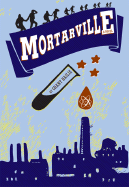
Mortarville, by Grant Bailie
A thoughtful narrative. Read this while my girlfriend shopped the farmer’s market.
Reading this made breaking my foot entirely worthwhile. Splendiferous piece of work.
Writing this has made me realize one thing: the true “crises” in book reviewing? The lack of use of the word “splendiferous”. One day, when I run the NBCC, that’ll change.
Russ Marshalek is the marketing director for Wordsmiths Books. He's also clumsy as hell. As an addendum, in the time between writing this and posting it, he fell again and twisted the same foot in the opposite direction. Fingers crossed that, tomorrow morning, this results in the most well-stretched left foot possible, and not another debilitating injury.
Monday, February 25, 2008
Let's Hear It for Laughter

Example: My husband and I live two doors from a lovely walking trail. On Sunday afternoons we stroll along admiring plants and trying to identify birds by their calls. We meander for an hour or two while discussing our week, pausing often to look up at striations in a rock face or down into a rushing brook. As we walk, we play a game. We rate other folks on the trail by their Earnestness levels.
Our local joggers, bikers, skaters, and even walkers are amazingly serious about what they do. Almost all wear the intense look of astronauts stranded on a dark and distant planet who must come up with the formula for repairing the space ship before their oxygen runs out.
All the while they are competing for those unseen judges, they are also whizzing past us, judges of their E - levels.
“There’s a nine,” we say.
“She’s definitely an eight.”
“Give her a twelve on a scale of ten.”
Each summer, the trail is lined with bushes heavily laden with fat blackberries. Bob takes off his hat and we fill it for a cobbler or to top our ice cream. Amazing, as crowded as the trail is, that so few people except us and our grandson seem to notice the blackberries.
Some folks are so serious about their exercise that they involve their children. Joggers push triangle strollers. Bikers pull kids in rickshaws. The kids are asleep or look utterly bored, but their parents can’t see that, so they wear the pleased, intent look of adults who are seriously multi-tasking: getting exercise while spending quality time with their kids.
Most of those who run, walk, bike or skate in pairs don’t talk to one another, but some do bring their cell phones to keep up with current events, business, and the status of their divorce.
We gave the twelve to a mother who was simultaneously jogging, pushing a bored tot in a stroller, AND conducting an intense conversation with her ex-spouse on her phone.
The odd part to us is, these people seem to think they are having fun. How do they look and act when they are serious?
Some Sundays I want to call, “Lighten up! Have you looked at your expression in a mirror lately? You aren’t training for the Olympics out here. We've got a blue sky here, a nice spring breeze, new wildflowers since last week, and fascinating rock formations. Forget staying in the zone. Look around you and smile. Can you remember the last time you laughed out loud?”
I don’t really want them to change, though. If they did, what would I have to chuckle about on Sunday afternoons? And where would I get characters for my books?

My tenth—and last—Thoroughly Southern mystery came out this month. WHAT ARE YOU WEARING TO DIE? is about the deaths of two young mothers in a small Georgia town that finds itself drowning in methamphetamine. Not a humorous subject, but I find levity can help the pain go down. One reader wrote, “I laughed and I cried.” What author could ask for more?
For more on my books, visit me at my website, http://www.patriciasprinkle.com/
Thursday, November 1, 2007
New Books by Edie Hand
Hi All,
I hope you enjoy my new books! I know I will all of yours. Please support your favorite charities but if you don’t have one please consider the ones on my www.ediehandfoundation.org site.
I help raise awareness through the books and PR. The reason I am so passionate about these charities is because I have loved and lost with all three of my brothers dying young and I’ve battled cancer three times and still struggling with a rare bacterial disease. I tell you this to encourage others to have hope in hopeless situation. I share a lot of this in my new book The Last Christmas Ride to honor my three brothers and remind others about lessons learned in life through tough times. Acts of kindness are who we are!
Thank you for inviting me into your world of Southern Writers. Stop by my site at www.ediehand.com and visit me on one of my tour stops or hometown speaking gigs. God bless with lots of hugs.
Edie Hand
Thursday, October 25, 2007
I’ve been thinking a lot about stores lately. About stores and the way they make writers. Just about every writer I know of has a store of some kind in their past. Lee Smith—the Patron Saint of Southern Writers—often talks about the influence of growing up in her father’s five and dime in downtown Grundy, Virginia. Pamela Duncan (whom I call “Sister,” like any good Southern man would call his female best friend) recently posted right here about growing up listening to her grandmother, who was a wonderful store in her own right. Lots of Southern writers will tell you about grandmothers or Mamas or aunts being stores that taught them how to tell a story. One of my favorite writers, Thomas Hardy, soaked up much of the knowledge he would later use in his writing by attending the many square dances where his fiddler-father and uncles performed almost every week. Willa Cather’s most beautiful novels are the ones that were most heavily influenced by the store she lived in, a store populated by sad and beautiful immigrant women who would become the basis for such strong characters as Alexandra in O Pioneers and the title heroine of My Antonia.I had so many stores I’ve had to sit down and make a list of all of them, and it’s been near impossible to figure out which was the most important.
First, there was the literal store I grew up in, my aunt’s little jottemdown store that served the tiny community of Fariston, Kentucky. Dot’s Grocery. If you don’t know what a jottemdown grocery is, that’s the kind of store you never, ever see any more. It was called a jottemdown grocery because on the counter there always laid a big, ragged, spiral notebook. At Dot’s, it was usually one from the Dollar General, bought twenty for a dollar at the start of the school year, more than likely with a red cover. Each page was headed by the name of a local community member. When they’d come in and get their groceries, Dot would figure up their tally and then they’d turn to their page and jot down the amount they owed her, which would be paid whenever their paycheck came in. Jottemdown. That’s what everybody called such stores back then, which really wasn’t so long ago. This was in the 70s and 80s, before WalMart took over America, back when a widow woman like my aunt could start her a little store in a little bitty house close to the road with a few candy bars, cigarettes, a good cold pop cooler, and actually see it grow.
Lots of people never paid off their credit at Dot’s Grocery, but every day they offered their stories, which I was always eager to hear. I loved to be in Dot’s Grocery with the big Stokermatic stove that got so hot it sometimes glowed red and the shelves and shelves of diapers and canned soup and Zagnuts and the big, terrifying, gold-framed picture of the blonde-headed Jesus looking down on us with longing in his sad blue eye, as if he too wanted to be part of the conversation. Here I learned about Mamie Spurlock’s kidney problems and Lester Conley’s many inabilities and Hy—short for Hyacinth—Shepherd’s affair with Vestal Stacy, who just so happened to be the preacher at the Holiness church where she was the choir leader.
But I learned more than just gossip: I learned about kindness when my aunt Dot grew sorry for poor mothers and gave them gallons of milk, erasing their marks in the notebook after they had left. I learned about boundaries when aunt Dot would run the same girls off if they had figured out she was kind-hearted and started to take advantage of her. I learned, by studying her in moments of silence, about being blue, which is something she went through her whole life, and is something people rarely talk about these days. In Dot’s moments of blueness I learned about silence—the nit nit of that red plastic clock that hang behind the register—even though she hardly ever stopped talking when she was in a good mood.
People in my family rarely stopped talking. We were raised to believe that it was impolite to let a silence fall. We told stories to survive. One of the few places in the world we ever hushed up—and rarely even there—was another store I grew up in: the Lily Holiness Church, where I spent two or three nights a week and every Sunday morning of the first seventeen years of my life. My brain and soul have the scars to prove it.
Despite how it messed me up to be raised going to church so much, I have accepted that that store was integral to my becoming a writer, and to my becoming a person. Here I learned how to observe, how to memorize, how to study people properly, and from different angles. There is not much formality in the Holiness church (one of its true qualities), so I was often allowed to stretch out beneath the pews, where I could closely—and unbeknownst to anyone else—study the lower parts of people. You can learn a whole lot about people from studying them only from the knee down. Some people never polished their shoes, for instance. Some people polished their shoes to a fare-thee-well. Some people come to church with mud caked on their shoes. These are important details to writers.
The most fun was to be beneath the pews when everyone started “shouting,” which is when they would holler out and dance in place and speak in tongues. I laid there and imagined an earthquake had come, or that God was holding the floor at opposite corners and bending it up and down to have his way with his Children. Sometimes I would doze off and awake to silence—very rarely, but sometimes, usually only when someone had just finished speaking in tongues and was waiting for the translation—and I would be assured that the Rapture had come and I had been the only one Left Behind. When this happened I always raised up too quickly, knocking my brains out on the hard underwood of the pew, the hit plomping out into the quiet of the church like a baseball being struck by a fast bat.
I learned the power of music and the hugeness of words was reinforced to me every single time someone would get up to testify and poetry would mysteriously fall out of their mouths. These were good, hard-working people who didn’t have much else but going to church, and when they stood up to give their testimony, well, it could make a believer out of anybody.
The most important store, however, was my own family. We Southern writers tend to always go back to them, sooner or later. They’re all the material we’ll ever need.
My family was—is—loud and fiery. They grow tender as easily as they grow angry. And they know how to tell a story. They exaggerate, they zoom in on the perfect detail, they establish a rhythm. These are three of the most important thing a writer can learn.
There was my Uncle Dave, who was also an accomplished quilter, taught by his mother during an especially bad winter when they couldn’t get outside to work on anything else. But he was an even more accomplished story-teller. He told epics. Often family gatherings turned into a listening session when Dave would hold court, everyone gathered near while he kept us on the edges of our seats, either telling a ghost story or a funny story or some adventure he had had at some point. My favorite was the one about him riding a mule in the house just to scare his mother.
“She was cutting a big hen up to fry,” he’d start out. “I believe it was Christmas. Or Thanksgiving one. I don’t remember which. But she was hard at it, son, cutting that hen up, and I rode that old mule in real easy, real slow, gentle as you please, and got him right up behind her and all at once she felt his breath on her neck and she turned around—real real slow—and then she was eye to eye with that big old nasty mule and she just throwed that hen right up in the air and run out of the house.” He went into a fit of laughter, and through his glee, puffed out the rest: “And. That. Little woman. Never was afraid. Of nothing. But that liked to scared her. To death.”
I knew that one was too good to pass up; I used it in my first novel and received dozens of letters about that scene alone.
He sang little songs:
There was, most of all, my aunt, Sis, who always had a Winston planted firmly between her teeth. Sis loved music better than anyone I have ever known. She must have had ten thousand record albums, which I was assigned to keep in alphabetical order even though she never put them back where they belonged. Sis was ten years older than my mother and had taken on the position of grandmother in my life. I stayed with her as much as possible—often to escape going to church—but mostly because she let me do whatever I wanted. With Sis I could set up and watch the Late Movie, or Johnny Carson, or reruns of “The George Burns Show.” She’d make chocolate fudge at midnight, let me drink coffee, had me read articles out of her True Story magazines to her while she rested her eyes with a washcloth across her forehead, the blue smoke of the Winston twirling between us.
Sis did not have great judgment, bless her heart. She took me to see The Exorcist when I was four years old, for God’s sake. But her bad judgment was my great fortune, because every Saturday she and I went “yard-saling,” her favorite and most oft-used verb. And on these yard sale and flea market trips, she let me buy any book that I wanted. She had bought me a guitar in the hopes that I might become the next Eddie Rabbit, but when that didn’t pan out she realized that I might not have the desire to be a country singer but I sure had the determination to be a writer. So she bought me books. One of those books was Peyton Place, by Grace Metalious, which I found at the bottom of a greasy cardboard box at the flea market.
“Aye Lord, that’s a good’n right there now, I tell ye,” she said, talking around her cigarette, squinting at the cover of the book through the smoke. “I read that when it first come out, twenty year ago. It was a scandal, that book was. You’ll love it.”
I was nine.
So, that day she bought me two of the most important gifts anyone has ever given me: a tattered paperback of Peyton Place, and a ginormous Royal typewriter, which was solid metal. The typewriter was as big and brown as a small tank; it must have weighed two hundred pounds. Me, Sis, and the man who had sold it to us had to carry it to the car. But I ended up writing the first draft of my first novel on it.
Even though Peyton Place was considered incredibly dirty when it first came out in the 1950s, there is no denying the beauty of the prose in that book. Its influence can be found in all of my descriptive writing and also in the ways I try to get at the operations of a small town’s heart. In a way, I’ve always been trying to write a book that Sis will love as much.
There was also Mamaw, who always sprinkled new colloquialisms into her tales. Among my favorites was when she told me the story of my grandfather coming to the boarding school where she was a student to whisk her away on a date against the schoolmarm’s wishes. Mamaw sat on the couch, wrapped in a sweater and hunched over the heat register in the floor even though it was June outside, and said: “I stood up there on the big high porch and seen him down there on his little horse,” she said. “That mountain was steep as a calf’s face but buddy he just rode right up there and got me. I wrapped my arms around his waist and never did look back.”
I have an image of myself as a childhood that I have more than likely made up. But it most likely happened at one point. Sometimes I see myself as a eight year old, standing in the middle of the living room, which is absolutely filled with every person in my family, all of whom are caught up in the act of telling a story. Some of them rear back and laugh, slapping their knees, probably laughing at their own jokes. Some dot Kleenex to their eyes, upset by their stories. Others are so caught up in telling their stories that they barely pause to breath or check to see if anyone is listening to anymore. A murmur that rises to a roar that threatens to blow the roof right off my childhood home’s house. The power of words, rising and rising.
That’s what is always present at these stores we writers remember, whether that store was the family or the church or a real little jottemdown store: words. Sentences. Stories. Language.
We survive because of stories. We live to tell our tale, to hear a tale told, to be part of a tale that is in the process of happening, just so it can be told later. People might think we Southerners are all ignorant and illiterate but secretly we’re all obsessed with words. I’m thankful for that, because otherwise I wouldn’t get to do what I love for a living. So every book I write is for the people who made me, the stories that made me. For the words.
Thursday, October 11, 2007
The Writing Path

by Pamela Duncan