Last month, I read Susan Cushman's blog on learning from the outtakes from the TV show The Good Wife - incidentally my husband's favorite, as well - and I thought of my own favorite TV show.
No, it isn't new. In fact, I'm probably giving away way too much if I tell you that it debuted in 1989 and lasted three seasons. Yes, I still love it, and yes, I do occasionally give myself permission to stream a few episodes on Netflix. It’s a damned good show, and it’s held up pretty well over the years, too. Historicals have a way of doing that, since they avoid getting dated by wardrobe and hairstyle the way contemporary shows do. (Consider that a free nugget of advice: don't date your writing by being too trendy. Unless you're e-publishing, and you're willing to rewrite frequently, avoid mentioning anything too pop-cultureish.)

My husband gives me a hard time about watching all the young man-candy, and I can sort of see his point, but the truth is, I’ve actually learned a few things I can apply to my own writing from watching those old episodes. And I’m not just talking about the idea I have for a wild west mystery.
When the idea for the show was first conceived back in the 1970s, it was focused on the character called The Kid. (No, he never did have another name. It became a running joke, all the way up until the wedding in the series finale.) In early 1989, when the pilot was filmed, the series still had that focus, and was supposed to be called simply The Kid.
But in picking up the series, the network decided that it should be about all the characters, not just one. The title of the show changed to The Young Riders and episode 2, which is called Gunfighter, was about another young man. And let me take a break here to say that in any group, real or imagined — be it the cast of a television show, the characters in a book, a bunch of kids on the playground, or coworkers in an office — someone’s gonna emerge as the natural focal point. It may take time, but it always happens. And it isn’t always who you think it is.
(Although in the case of The Young Riders, let me just express my incredulousness for one measly second and say that how the hell the producers expected to use Wild Bill Hickok as one of the characters and not have him take over, is beyond me.)
 But that’s the second thing I learned. As writers, let’s not presume to think we know how things are going to turn out when we first start writing our stories. Let’s please keep an open mind as to how the story will develop, and which of our characters will turn out to be more important and which less so, because too much of the time, holding on tightly to our own ideas of what’s going on can prevent us from seeing a much better storyline opening up ahead.
 However, sometimes we’ve already shot ourselves in the foot by that point, and we can’t take advantage of the new direction our work is going. We can’t let it develop naturally, organically, the way it should. And here’s why, again using The Young Riders as an example:
Everyone in the world, or at least in America, has heard of Wild Bill Hickok. He was a real person with a real history, one that many people are familiar with. And there were only so many changes the producers of The Young Riders could make to his character. They made him younger than he would have been in 1861, they gave him a job with the Pony Express that he never had, and they gave him a difficult family history. The Young Riders’ Jimmy Hickok can’t read, while James Butler Hickok was actually pretty well educated.
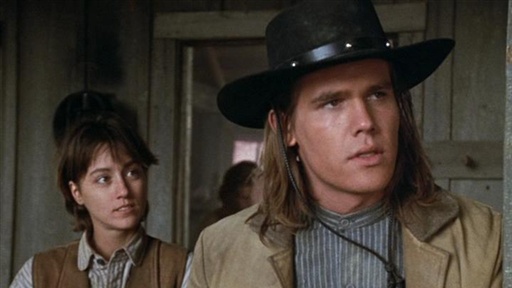 And here’s another thing: Already in the first episode, the writers set up a romantic relationship between The Kid — who was supposed to be the main character, remember? — and the only girl in the bunch, who was pretending to be a boy in order to keep her job. That relationship hit a snag in season 2. However, another of the boys had noticed the same girl, and we got a little bit of a romantic love triangle going. I’ll give you three guesses as to which boy it was, and I won’t hold my breath while you guess.
 Jimmy and Lou — that was her name — had a hell of a lot more chemistry than Lou and The Kid ever did, and would probably have been very happy together, but this was where those problems cropped up again. The real James Butler Hickok didn’t get married in 1861, nor was there any way anyone would believe that the character as he was played would have left the girl he loved to scout for the Union army. Yet that was what Wild Bill did during the Civil War. It’s a historical fact. So a relationship that had such potential on screen ended up fizzling out into nothing. Because of inconvenient facts.
Now, I know that most of us don’t write about historical characters with real histories we have to work around, but the same issues can come up in our books, if we give out too much information too soon. Some of us plan out everything about our characters before we even sit down to write, and if we put too much of that information into our books before we have to, we’ve hamstrung our characters. On the other hand, some of us write by the seat of our pants, and just give our characters a background, any background, without much thought to the future. Sometimes, something wonderful might develop in book 3 of a series. But if we’ve already established in book 1 that the character came from elsewhere, the background was different, he/she doesn’t have any cousins, is the wrong age, can’t read... we’ve taken away the opportunity to benefit from whatever wonderful thing it is.
Obviously I’m not saying not to give out the information that’s necessary to develop the character. And part of the fun of watching 18-year-old Jimmy Hickok turn into Wild Bill is knowing what will happen to him later. But in the case of The Young Riders, it also limited what could be done with that particular character, and it can do the same thing to our characters and our books if we don’t watch out.
So that’s my bit of wisdom for the day. I’m off to watch some reruns of Firefly now. Research, you know. For that science fiction romance I might write one day.
And if you have any golden nuggets of knowledge gleaned from TV or movies, feel free to share!
* * *

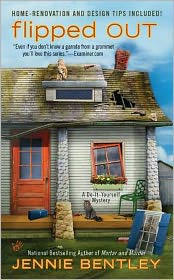 Jennie Bentley/Jenna Bennett writes the Do It Yourself home renovation mysteries for Berkley Prime Crime and the Cutthroat Business mysteries for her own gratification. The 5th DIY mystery, Flipped Out, will be arriving in stores October 4th, while the 4th book in the Cutthroat Business ebook mysteries, Close to Home, was released September 1st. You can find out more about both series at http://www.jennabennett.com/


